New York City’s vibrant and diverse arts and culture sector is arguably the city’s greatest asset—sparking local economic vitality, inspiring New Yorkers and visitors alike, and knitting communities together in the face of immense challenges. But the sector and its working artists are facing serious challenges of their own that threaten the city’s continued ability to thrive—none more urgent than the dire lack of affordable housing accessible to artists.
New York City has fallen behind the rest of the state—and the nation—when it comes to developing artist housing. Over the past decade, U.S. cities have created more than 2,804 units of dedicated artist housing—with another 1,274 approved or under construction—and not a single one is in New York City.1 That’s a striking reversal for a city that once led the way with pioneering projects like Westbeth Artists Housing (1970) and Manhattan Plaza (1977) that became national models.
Since 2019, the resident artist population has fallen 4.4 percent—the first sustained decline in decades—including an 18.8 percent decline in dancers, an 8 percent drop in actors, and a 2.8 percent decrease in musicians. Historical artist neighborhoods are now losing artists: The Upper West Side has lost nearly 32 percent over the past decade, and the artist population has plunged 55.5 percent on the Lower East Side. Meanwhile, more affordable cities and regions are gaining artists: the Hudson Valley’s artist population is up 7.2 percent since 2019, Philadelphia has grown 8 percent, and Nashville has surged 18.9 percent.2
Artists contribute immensely to the city’s well-being—serving as a magnet for talent and tourists, burnishing New York’s standing on the global stage, preserving traditions and healing communities, and envisioning more inclusive and sustainable futures. Yet their toehold is increasingly tenuous: New York City’s artists earn 22.6 percent less than the national average after adjusting for the cost of living—a gap that has widened from 15 percent a decade ago.3
Reversing this trend will require major steps to boost housing supply citywide. It should also include affordable housing set-asides for this vital and uniquely threatened population—a step policymakers have been reluctant to take in recent years.
Two key barriers have stalled progress, stemming from the same issue. Housing officials worry an artist preference could violate fair-housing laws, and policymakers have raised concerns about the optics of creating housing specifically for artists. Both rest on U.S. Census data that undercount artists by recording only a person’s primary income-earning occupation. That method leaves out many working artists—especially artists of color—who cobble together income from multiple streams, making the city’s artist population appear less diverse than it is. More inclusive, large-scale surveys, however, show that a majority of the city's artists are people of color, and only 18.6 percent earn all of their income from art. In short, relying on the U.S. Census undercount has a perverse effect: it blocks the very tool—well-designed artist-preference housing—that can curb displacement and create a more inclusive arts sector.
Fortunately, policymakers have a path forward. Cities and developers around the country have addressed legal concerns and secured approvals for dozens of new developments now filled with diverse artists. Encouragingly, the City Council is considering legislation introduced by Council Members Erik Bottcher and Keith Powers that would allow city and state housing programs to provide an artist preference without violating the human rights law which prohibits against discrimination on the basis of occupation. Alongside efforts to enable the creation of hundreds of thousands of new homes, the Mamdani administration can restore the city’s leadership by building an artist preference into a small share of new affordable units—aligned with state guidance, using inclusive definitions and fair marketing, and modernizing lottery rules for freelancers and gig workers. Arts organizations and nonprofit developers are ready to partner; if the city clears the way, New York can again set the standard for equitable, affordable artist housing.
This report examines the current state of affordable artist housing in New York City, analyzes the economic and equity case for advancing these policies, identifies the three biggest challenges to progress on artist housing, and puts forward a set of six practical recommendations for policymakers—including the Mamdani administration:
6 ideas to create the affordable artist housing that New York City needs:
- Commit to 5,000 artist-preference units by 2030 through small set-asides in citywide affordable housing projects, prioritized on public land and in mixed-income deals.
- Issue clear HPD guidance on artist-preference policy modeled on existing state standards to unlock stalled proposals and ensure fair, inclusive implementation across all boroughs.
- Launch a biennial NYC Artist Survey to gather accurate, inclusive data on the city’s artists, and to publish an annual dashboard to guide equitable housing and cultural investment.
- Develop zoning and code standards for safe, practical live/work artist housing through a citywide Artist Live/Work Standard and targeted overlays legitimizing and enabling creative mixed-use spaces.
- Support artist-preference set-asides in office-to-residential conversions and classify time-limited artist residences as community facilities, where appropriate, to unlock more space.
- Create an Artist Housing Accelerator to fund early-stage costs like outreach, certification, and shared space buildout, helping more projects move from concept to construction.
I. Affordable Housing is Major Barrier to Keeping Artists in NYC
Even after a highly challenging five-year period since the COVID-19 pandemic first hit, New York City still maintains the largest creative workforce and resident artist population in the country. However, our research finds that the housing crisis is driving a growing number of artists and other creatives to leave as they face skyrocketing costs for rent and studio space, even as their income fails to keep pace. The reality today is that New York is losing artists—and this alarming trend shows few signs of abating.
“Being able to afford to actually make things in New York has gotten exponentially worse since the pandemic,” says Theresa Buchheister, former artistic director of Brick Theater in Brooklyn, who recently left New York for Kansas after 20 years in the city. “The revenue that an artist brings in—from their day job, a grant, hustling, ticket sales, whatever—the revenue can't match the expenses if the cost of living is just too high.”
It wasn’t always this way. New York was one of the first places in the country to build artist-specific affordable housing when it converted the historic Bell Labs complex in the West Village to artist apartments in 1970. But New York City has since fallen behind dozens of other cities nationwide on developing housing with set-asides for artists, with zero affordable housing units built specifically for artists since El Barrio’s Artspace PS109 opened a decade ago.
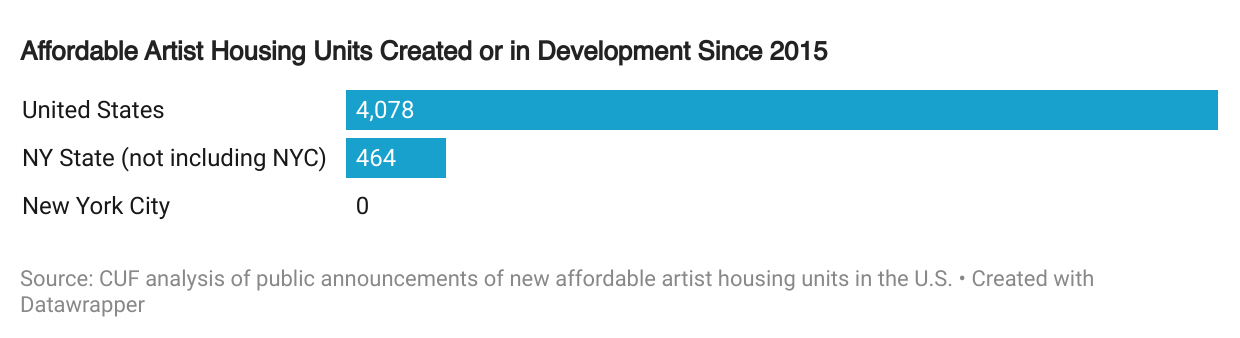
From coast to coast, cities are opening new artist-preference developments: Boston alone has approved or built at least 16 in the past decade; in Los Angeles, the Entertainment Community Fund completed the 151-unit Hollywood Arts Collective; and metros from Minneapolis and Detroit to Pittsburgh and Atlanta have added multiple projects. Closer to home, New Rochelle, Patchogue, Ithaca, and Poughkeepsie have opened artist housing in New York State, with new developments underway in Utica and Rochester. In all, more than 5,610 units have opened nationwide in the past 25 years—with just 329 in New York City. And the vast majority of units were built in the past decade, but none in New York City.
Meanwhile, the artists who bolster the city’s economy and enrich the lives of all New Yorkers are increasingly looking elsewhere for an affordable life. The city’s resident artist population—including fine artists, actors, directors, dancers, choreographers, musicians, editors, writers, and photographers—declined 4.4 percent since 2019.4 In some artistic fields, the losses have been staggering: the city’s population of set and exhibition designers plunged 44.7 percent, dancers dropped 18.8 percent, actors declined 8 percent, and composers fell 7.6 percent.5 At the same time, thousands more artists who weren’t deriving their income from their art have likely left the city, too, or put their artistic careers on hold in order to make ends meet.
On a neighborhood level, many communities long known as thriving artist hubs have seen a significant exodus as rents have skyrocketed. In the Lower East Side/Chinatown, the artist population has plummeted 55.5 percent since 2013. The city has also seen a loss of artists from neighborhoods that were growing until recently. The artist population dropped 18 percent in Chelsea and Hell’s Kitchen, 17 percent in Harlem, and even 5 percent in Bushwick—one of the city’s fastest-growing artist neighborhoods over the past decade. Meanwhile, the artist population has leaped up in several of the city’s lowest-income neighborhoods over the past decade, including Highbridge/Concourse (from 101 to 996, an 886 percent increase), East Flatbush (163 to 968, a 494 percent increase), East New York/Cypress Hills (67 to 684, a 921 percent increase, and Ocean Hill/Brownsville, (45 to 574, an 1,176 percent bump).6 But as rents continue to rise, even these neighborhoods may not be able to hold onto their resident artists for long.
Although it’s no secret that artists have long faced economic instability, cost pressures have reached a breaking point in recent years, underscoring the urgent need to ramp up the creation of affordable spaces for artists to live and work across the five boroughs.
“I receive an emergency grant application for somebody facing housing insecurity at least once a week, but sometimes more,” says Randi Berry, executive director of theater nonprofit IndieSpace. “And the overall number of applications we're getting for housing insecurity and food insecurity has increased significantly in the last six months.”
Indeed, 89.7 percent of New York City artists reported earning less than $50,000 a year in 2022, according to an analysis of data from a statewide survey conducted by Creatives Rebuild New York. Nearly two-thirds (64 percent) said they did not have a financial safety net for a $400 emergency, and 48.5 percent characterized themselves as gig workers.7
“Artists are the working poor,” says Lucy Sexton, a performing artist and executive director of New Yorkers for Culture and the Arts. “It’s astounding how little they make.”
A growing number of artists and arts leaders say that despite all the challenges facing the arts today—from federal funding cuts to the rise of artificial intelligence—the lack of affordable housing options for artists and cultural workers has become New York’s greatest threat.
“If artists and creatives and actors and everyone else can't afford to live here anymore, then the magic dies,” says Eric Shiner, president of Powerhouse Arts. “Our teams are finding it difficult to stay here, even with fairly competitive salaries. This is a bigger societal issue that the city can help solve with more affordable housing, more affordable artist housing, and live-work space.”
Artists of color, in particular, are at growing risk of displacement, as income growth fails to keep pace with rising rents. Recent survey data suggests that New York City’s overall artist population—those with an artistic practice, regardless of their primary source of income—are lower-income, more racially diverse, and more likely to identify as LGBTQ+ than the city as a whole. And while all artists in New York City earn less, after adjusting for the cost of living, than the national average, that gap is wider for artists of color who typically earn less than their white peers in nearly every creative field for which data is available.8
“Artists are the most vulnerable among us,” says Sade Lythcott, chief executive officer of the National Black Theatre. “We have the worst story, right? Because everyone sees ‘artists’ and they think of someone very wealthy like Julian Schnabel or Sarah Jessica Parker, as opposed to the most vulnerable gig workers that don't have any kind of safety net.”
Lythcott says that keeping artists of color in the city and close to each other has been key to their ability to create. Her mother, the theater artist Dr. Barbara Ann Teer, founded the National Black Theatre with the aim of housing Black artists in Harlem and fostering an arts community in the neighborhood. As part of that goal, the National Black Theatre is developing a mixed-use building with a new home for the theater, retail, and affordable residential space at 125th Street and Fifth Avenue.
“No one can imagine a more innovative, vibrant future than the artists,” Lythcott says. “And if the artists can't live here, then this is no longer a city that's viable for all of the reasons why it is unique and singular in the world.”
Even as New York City’s affordable artist housing production has flatlined, other cities have stepped up efforts to create housing for artists—including Austin, Minneapolis, Detroit, Los Angeles, Pittsburgh and Atlanta, as well as New Rochelle, Poughkeepsie, and Buffalo in New York State.
Cities have taken steps to integrate artists into housing plans both to help create more vibrant communities in distressed areas and to support low-income artists in increasingly expensive cities.
Adam Salgado, the development commissioner for the city of New Rochelle, says that artists and creatives have been essential to the city’s strategy to revitalize its downtown. He helped develop an artist certification program and affordable housing policy for the city as part of its downtown master plan and rezoning approved in 2015.
“You’re plugging in residents that are naturally entrepreneurial, that are trying to make it with a talent that they’ve perfected themselves,” says Salgado. “Those are the people that transform public spaces, help start community gardens and food coops, and invest in the community.”
In Austin, nonprofit Imagine Art recently finished a 66-unit supportive residential project for low-income artists that includes full-time medical care, free meals, creative studio spaces, and offices for the organization, which works with disabled and homeless artists. Debbie Kizer, executive director of Imagine Art, says that her goal was to provide comprehensive care and support to artists who are often living on Social Security, disability benefits, and food stamps, and either living with relatives or struggling to pay rent.
“Our goal is to prove systems change,” she says. “You can leverage the power and beauty of the arts to change something. That’s the power of creative placemaking. We’re trying to raise up our artists.”
II. Key Challenges to Unlocking Artist Housing in New York City
1. Legal challenges and fair housing concerns have slowed progress in New York City to a standstill.
Although New York State and cities across the country have developed frameworks to address the legality of an artist preference policy, New York City’s reluctance to build affordable housing for artists hinges on legal concerns around violating fair housing law. More specifically, the city’s housing officials and attorneys worry about violating the disparate impact standard, which means that housing cannot be built or operated in a way that might be discriminatory against legally protected categories of people—including on the basis of race, ethnicity, sexual orientation, gender, occupation, or disabilities.
One concern is that setting aside housing specifically for artists might inadvertently favor white New Yorkers, because U.S. Census population data suggests that the city’s artist population trends whiter than New York City in general. Another worry about reserving affordable units for artists is that it might violate New York City’s Human Rights Law, which forbids housing discrimination based on source of income and occupation.
The city also spent nine years litigating a federal court case over the concept of community board preference in the city’s affordable housing lottery, which set aside 50 percent of units in a new affordable building for people who lived in the neighborhood. Fair housing groups argued that community preference created disparate impact and violated the city’s Human Rights Law by further encouraging racial and economic segregation in New York City, and by disadvantaging lottery applicants who live outside the community district in which a development is located.
The suit was ultimately settled in January 2024 for $6.4 million. As part of the settlement, the city was forced to reduce community board preference in the lottery to 20 percent of units through April 2029, and then drop the share to 15 percent after that. After experiencing the community preference lawsuit, the city officials interviewed for this report say that there is a deeper culture of reluctance to adopt preferences in the housing lottery, although that resistance may be thawing. For instance, the city has supported an expansion of the municipal employee preference from 5 to 10 percent, and included veterans.
But advancing an artist preference policy would almost certainly require leadership from the mayor and City Council. Experts say the city’s housing agency is unlikely to advance this model on its own.
“We made several attempts over the years to engage the city and try to get an artist preference reestablished so that we can do more work in New York,” says Will Law, president of Artspace, a national developer of housing and workspace for artists. “And we could never get the momentum.”
For years prior to the settlement, however, the city’s attorneys did not view an artist preference as a violation of federal fair housing law, which has been in effect since 1968. For instance, the city permitted the conversion of Bell Labs into Westbeth Artists Housing in 1970, creating 384 Section 8 and rent stabilized apartments in the West Village. In the mid-1970s, the city supported the development of Manhattan Plaza, a 46-story, 1,689-unit building in Hell’s Kitchen with federally subsidized Section 8 apartments, of which 70 percent were reserved for performing arts workers.
More recently, the Entertainment Community Fund co-developed two projects—the 178-unit Dorothy Ross Friedman Residence on West 57th Street (built in 1996), and The Schermerhorn, a 216-unit low-income and supportive project in Downtown Brooklyn completed in 2009. Both include supportive housing for people living with HIV/AIDS and members of the performing arts community, while the Schermerhorn also houses formerly homeless people and offers on-site social services.
In 2014, prolific artist housing developer Artspace converted a long-abandoned school on East 99th Street into 90 affordable live/work units for artists with 10,000 square feet for arts organizations. Artspace’s PS109 has not faced legal challenges, and has achieved a diverse tenant mix, reflective of its surrounding community in East Harlem.
However, no affordable housing for artists has been built in the five boroughs in the intervening 11 years, despite a 2015 promise from then Mayor Bill de Blasio to build 1,500 units of affordable housing for artists.
2. A reliance on U.S. Census data has stymied efforts to create an artist preference policy
One major obstacle to creating artist-specific housing is the city’s reliance on data that paints artists and arts workers as less diverse than the city as a whole. However, recent research suggests that U.S. Census data dramatically undercounts artists of color—stymieing the very policies that could help retain diverse artists in New York City.
This disconnect stems from the way that the U.S. Census Bureau assigns residents to specific occupations. Residents are asked only about their primary source of income—and are considered an artist accordingly—leaving out the tens of thousands of New Yorkers with a meaningful artistic practice who, nevertheless, earn the majority of their income from other sources.
Experts say that the city’s Department of Housing Preservation and Development (HPD) points to data from the U.S. Census Bureau’s American Community Survey whenever developers approach the agency with the goal of building affordable apartments for artists. That data shows that lower-income renters employed in arts occupations are 55.9 white and 28.8 percent Black or Hispanic, compared to the citywide population, which is 18.2 percent white and 66.9 percent Black or Hispanic.
But more recent research suggests that this data grossly undercounts artists of color. Creatives Rebuild New York’s 2022 survey found that just 28.8 percent of artists surveyed in New York City identify as white. Nearly half (48.2 percent) identify as Black or Latino.
While it’s logical for city officials to consider Census data when it comes to understanding the relative diversity of industries and occupations where the goal is full-time employment, the arts is fundamentally different.
“At least 90 percent of the artists we work with are not making the majority of their living in the arts,” says Pete Rushefsky, executive director of the Center for Traditional Music and Dance, a nonprofit that supports performing arts traditions in immigrant communities. “But I wouldn’t call them hobbyists. These are serious, serious artists.”
The lack of robust demographic on the city’s artist population has proven to be a major obstacle to garnering city support for an artist preference policy.
“We don't have comprehensive enough data on who makes up the arts community in the city, and a big reason for that is its determination is based on census data,” said Randi Berry of IndieSpace. “We work with thousands of individual artists, but they have multiple jobs, and because of that, they tend to put their (non-arts) job first when they fill out the census. They are filling it out as the worker in the job that they're earning the most money in, which is may be a teacher, a waiter, an administrative assistant. They're not counting themselves as artists first, even though they may spend more time on their creative practice than they do on any other job.”Berry says that plenty of artists themselves fall into protected classes under federal and local housing law, but that the city is too worried about the specter of fair housing litigation to consider the possibility that it could fill artist-specific units with a diverse population while following the law.
“It's a risk tolerance that they don't have, but the protected classes would still be protected, just like they are in any housing lottery.”
City officials can see the real-world impact of well-designed artist preference policies both close to home and across the country. For instance, Artspace’s PS109’s tenants reflect East Harlem, with nearly half (47 percent) of tenants identifying as Hispanic or Latino, 25 percent as white, 17 percent as Black and 1 percent as Asian. And in the spring of 2024, Entertainment Community Fund completed Hollywood Arts Collective, a 151-unit low-income residential project for artists in Los Angeles. The tenant mix is 34 percent Black, 25 percent white, 15 percent “mixed race,” 12 percent Latino or Hispanic and 7 percent Asian.
3. Breaking the logjam will require clear guidance around how to develop an inclusive, equitable artist preference—and administer it effectively.
Developers of affordable housing for artists have had to forge their own path when it comes to artist preference policy in different cities and states. Artspace, which has developed thousands of units of artist housing across the country, created an artist preference process with the U.S. Department of Housing and Urban Development (HUD) that it has used without issue in most of its projects outside New York City. This includes elsewhere in New York State, with recent developments in Utica, Buffalo, and Patchogue.
“So we have projects in 22 other states and a lot of other cities, and we've been able to use this preference process successfully to give creatives a bit of a step up,” says Will Law, president of Artspace. “You can have a marketing preference for creatives and artists, if deployed with an even hand in a way that does not violate any other protected class.”
Artspace also negotiated an artist preference policy in 2022 with the New York State Department of Homes and Community Renewal (NYSHCR), which it has used for several projects outside New York City. The policy provides a potential roadmap for the city’s housing officials by outlining seven key conditions for using federal low-income housing tax credits for projects with an artist housing component. NYSHCR allows artist preferences in projects if they are limited to 20 percent of non-supportive units, supported by a documented market-demand study, and approved by the state’s Fair and Equitable Housing Office. Artist-preference units are required to be spread across income bands, marketed inclusively (with outreach to underrepresented artists), and comply with all affordability rules. In some cases—where an arts nonprofit is a development partner and funds programming—preferences may extend to 75 percent of units, provided the project also supports family housing and community arts space.9
In addition to guidance on the share of units that can be set aside for artists, policymakers need to contend with the challenge of who is an artist in the first place. Given the limitations of the data captured in U.S. Census, experts say that the key is to develop an assessment or certification process that is inclusive of artists who derive income from non-arts sources, or whose arts income is highly variable. And while some municipalities have taken on the responsibility of adjudicating who is an artist, experts suggest that the more effective path forward for New York City would be to develop this preference in partnership with arts nonprofits.
For its recently completed Hollywood Arts Collective residential project in Los Angeles, Entertainment Community Fund used one of two criteria to certify artists: income earned from three out of the last five years, or proof of commitment to artistic practice based on a portfolio review by a committee of artists and experts in the field. When defining artists for this project, the team mirrored an approach taken by the New York City Department of Cultural Affairs (DCLA) Affordable Real Estate for Artists (AREA) program established by Mayor Bill de Blasio.
Artspace takes a similarly expansive view, by asking artists to share examples of their commitment to an artistic practice. “We're not trying to jury people's art or make a judgment about how good this artistic expression is or isn't,” says Law. “It's really a process in which we say, ‘Do you self-define as an artist or as a creative? And if you do, can you tell us a little bit about your body of work?’”
III. Recommendations: 6 Ideas to Create the Affordable Artist Housing that NYC Needs
1. Commit to building 5,000 units of artist-preference housing by 2030, distributed citywide. New York should set a goal of developing 5,000 affordable homes with an artist preference by 2030, achieved through incorporating an artist preference in 5–10 percent of affordable projects developed under the city’s affordable housing framework. The mayor should embed this target in the next citywide housing plan and instruct the city’s Department of Housing Preservation and Development (HPD) and Housing Development Corporation (HDC) to develop an artist preference policy that is inclusive of artists with variable income or who do not make the majority of their income from their artistic practice. The city should also prioritize eligible projects on public land and in mixed income deals already in pre-development, where the city’s direct role provides additional leverage.
2. Integrate an artist preference into the city’s housing framework by issuing HPD guidance modeled on state policy. The mayor should direct the city’s Department of Housing Preservation and Development (HPD) to publish an Artist Preference Bulletin that mirrors New York State Homes and Community Renewal (HCR)’s framework and clarifies how to comply in New York City. Guidance could cap the preference (e.g., up to 20 percent of non-supportive units, with flexibility up to 50–75 percent when a qualified arts nonprofit partners on programming), spread units across income bands, and require inclusive marketing with outreach to BIPOC-led arts groups. Options include requiring a short market-demand memo and an equity review, plus a fallback that releases units to the general pool when artist demand is insufficient. HPD should standardize documentation (e.g. definitions of “artist,” acceptable proofs of practice/income including accepting multiple years of income statements and a portfolio/practice review) and provide a model tenant-selection plan. The artist-preference option should apply across all five boroughs and avoid concentration on any single site to align with fair-housing requirements. Issuing clear guidance will de-risk proposals and unlock a pipeline now stalled by uncertainty, stabilizing creative communities across neighborhoods while advancing the city’s broader affordable housing goals.
3. Launch a biennial NYC Artist Survey to produce accurate, inclusive data. The mayor and City Council should fund a recurring every-two-years survey led by the Department of Cultural Affairs (DCLA) and the NYC Economic Development Corporation (NYCEDC) to count the city’s artists—including the tens of thousands of artists overlooked on U.S. Census surveys because they derive income from other work. This survey should include demographic questions as well as information about income sources (W-2/1099/gig), housing status, financial health, neighborhood, and artistic practice. Unlike American Community Survey occupation counts, the survey should capture artists whose primary income is outside the arts and publish anonymized microdata so agencies and developers can plan inclusive projects. Findings should feed into HPD’s equity analyses, NYCEDC site request for proposals (RFPs), and DCLA grantmaking, and establish baselines for tracking displacement risk. The city should also publish a simple, annual dashboard which includes units created, applicant demographics, denials andapprovals to strengthen transparency. Better data will help support effective and inclusive policy and counter misperceptions that have blocked progress.
4. Create a zoning and code framework that enables safe, practical live/work space for artists. The City of Yes zoning reforms can unlock tens of thousands of new homes and modernize where businesses operate, but guidance around artist live-work space is still lacking. As a result, tenants and owners operate in a gray zone—co-ops and landlords block live/work uses, NYC Department of Buildings reviews are inconsistent, and developers avoid including dedicated creative space despite demand. The mayor should work with the Department of City Planning and the City Council to advance an Artist Live/Work Standard and Overlay—a targeted zoning text amendment that creates a clear, citywide path for residential live/work spaces, and pilots overlay districts in neighborhoods with artist communities. Clear rules will legitimize common practice and make mixed-use creative housing easier to deliver citywide.
5. Incentivize commercial-to-residential conversions and classify appropriate artist housing as a community facility where warranted. As the city streamlines office-to-residential conversions, it should offer zoning bonuses and New York City Housing Development Corporation (HDC) financing in exchange for a 5–10 percent artist-preference set-aside plus dedicated creative space. In parallel, the city should create a narrow, well-defined path to treat certain nonprofit-operated, time-limited artist residences (e.g., visiting-artist, training, or university-affiliated programs) as community facility use—unlocking spaces that too often go unused today as developers struggle to find tenants who can fill required community spaces.
6. Bolster the financing pipeline with an Artist Housing Accelerator. With a clear artist preference policy in place, most projects would be able to tap the existing affordable housing toolbox—but they still face unique costs that slow or sink good proposals. These include inclusive marketing and outreach, partnering with arts nonprofits, the artist certification process, live/work design considerations, and building out shared creative space. The city should create a modest, flexible fund that offers small grants or low-cost advances to cover these early expenses and bridge gaps until permanent financing closes. The Artist Housing Accelerator should include a single application, rolling awards, and a dedicated city point person to help sponsors stack existing programs. An Artist Housing Accelerator can help more proposals pencil out—supporting nonprofit and mission-driven developers and projects that distribute artist-preference units across differing area median incomes (AMIs) and neighborhoods—and move projects from idea to construction faster.
Endnotes
1. Center for an Urban Future analysis of municipal RFPs/approvals, developer disclosures, Artspace/ECF portfolios, and local press, 2015–2025.
2. Center for an Urban Future analysis of U.S. Census Bureau American Community Survey (ACS) 1-year microdata (IPUMS), 2018–2023.
3. Center for an Urban Future analysis of ACS 1-year microdata (IPUMS), 2013 vs 2023. Income is adjusted for the cost of living in Brooklyn and compared to the national average.
4. Center for an Urban Future analysis of ACS 1-year microdata (IPUMS), 2019–2023.
5. Ibid.
6. Ibid.
7. Center for an Urban Future analysis of data from Creatives Rebuild New York Portrait of New York State’s Artists, 2022.
8. Center for an Urban Future analysis of 2019-2024 5-year ACS microdata.
9. New York State Homes and Community Renewal, Fair and Equitable Housing Office, “NYSHCR Artist Preference Policy,” January 25, 2022, https://hcr.ny.gov/system/files/documents/2022/02/20220122-artist-preference-policy_0.pdf