From Broadway theaters to Bushwick studios, Bronx rehearsal spaces to Queens sounds stages, the creative sector remains one of New York City’s greatest economic engines and competitive advantages. The arts and creative industries employ more than 326,000 New Yorkers, attract millions of visitors each year, power the city’s global brand, and arguably serve as the city’s most important talent magnet in a talent-driven economy.
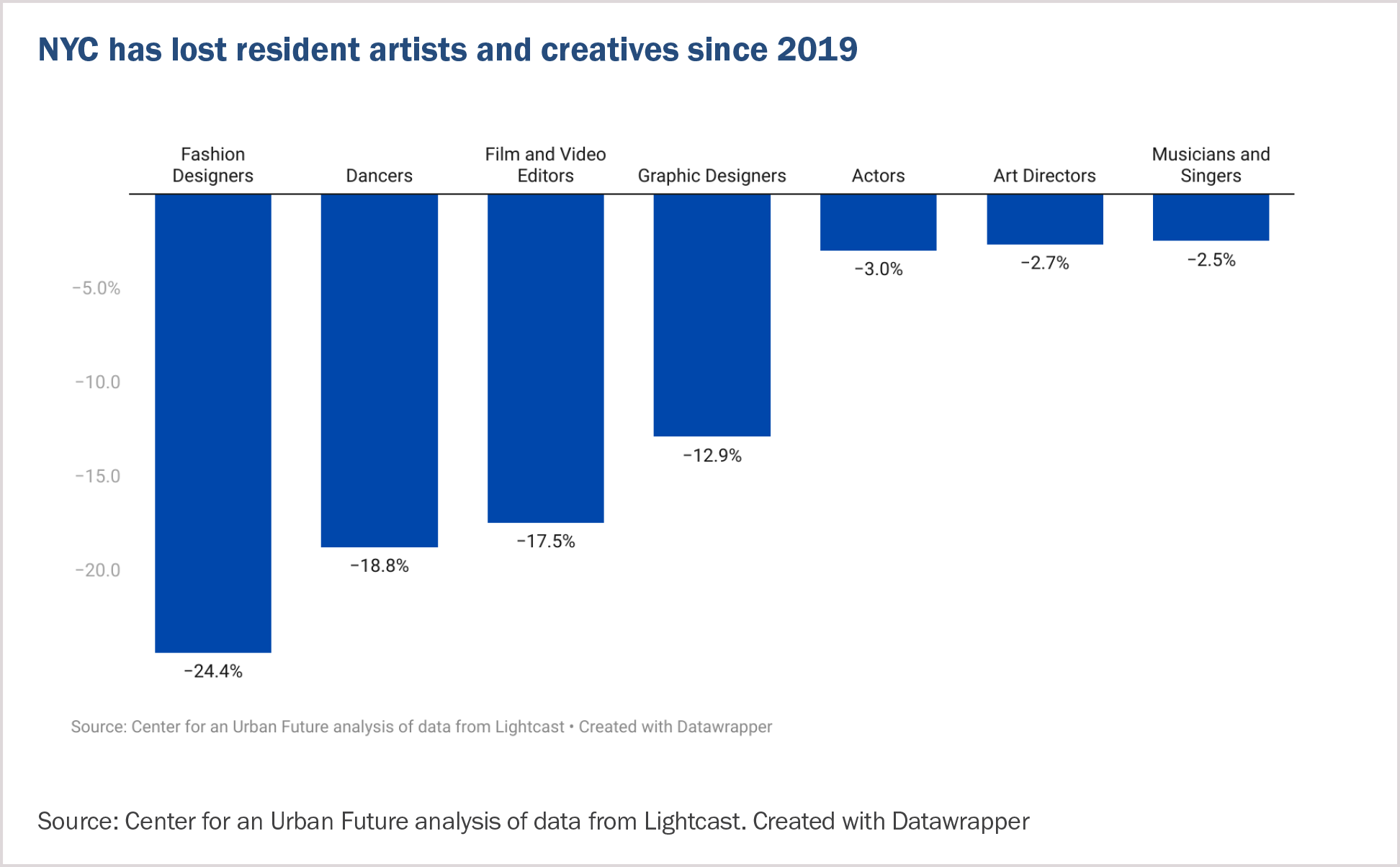
But after decades of steady growth in almost every part of the city’s creative economy, this vital engine is now sputtering. Since the start of the pandemic, the city has seen an 18.8 percent decline in dancers, an 8 percent drop in actors, and a 2.8 percent decrease in musicians. But it’s no longer just artists whose numbers are dwindling: fashion designers are down 25.9 percent, film and video editors 18.5 percent, graphic designers 13.8 percent, and art directors 6 percent.1
Meanwhile, creative industries that had been among the city’s fastest growing sectors in the decade before the pandemic are now lagging well behind. Between 2005 and 2020, employment in the city’s film and television sector increased by 113.7 percent. But since 2020, film and TV jobs in New York City are down by 19.1 percent. There has been a similar pre-and-post pandemic employment divergence in advertising (up 46.1 percent from 2005 to 2020, and down 15.7 percent since), architecture (+ 61.1 percent vs -9.4 percent), applied design (+12.5 percent vs -14.3 percent), performing arts (+30.2 percent vs -6.4 percent), and visual arts (+95.7 percent vs -1.3 percent).
The overall number of people working in the city’s creative economy—including jobs and self-employment in more than a dozen cultural and creative industries, as well as creative jobs in fields outside the creative economy—has declined by 6.1 percent since 2019.
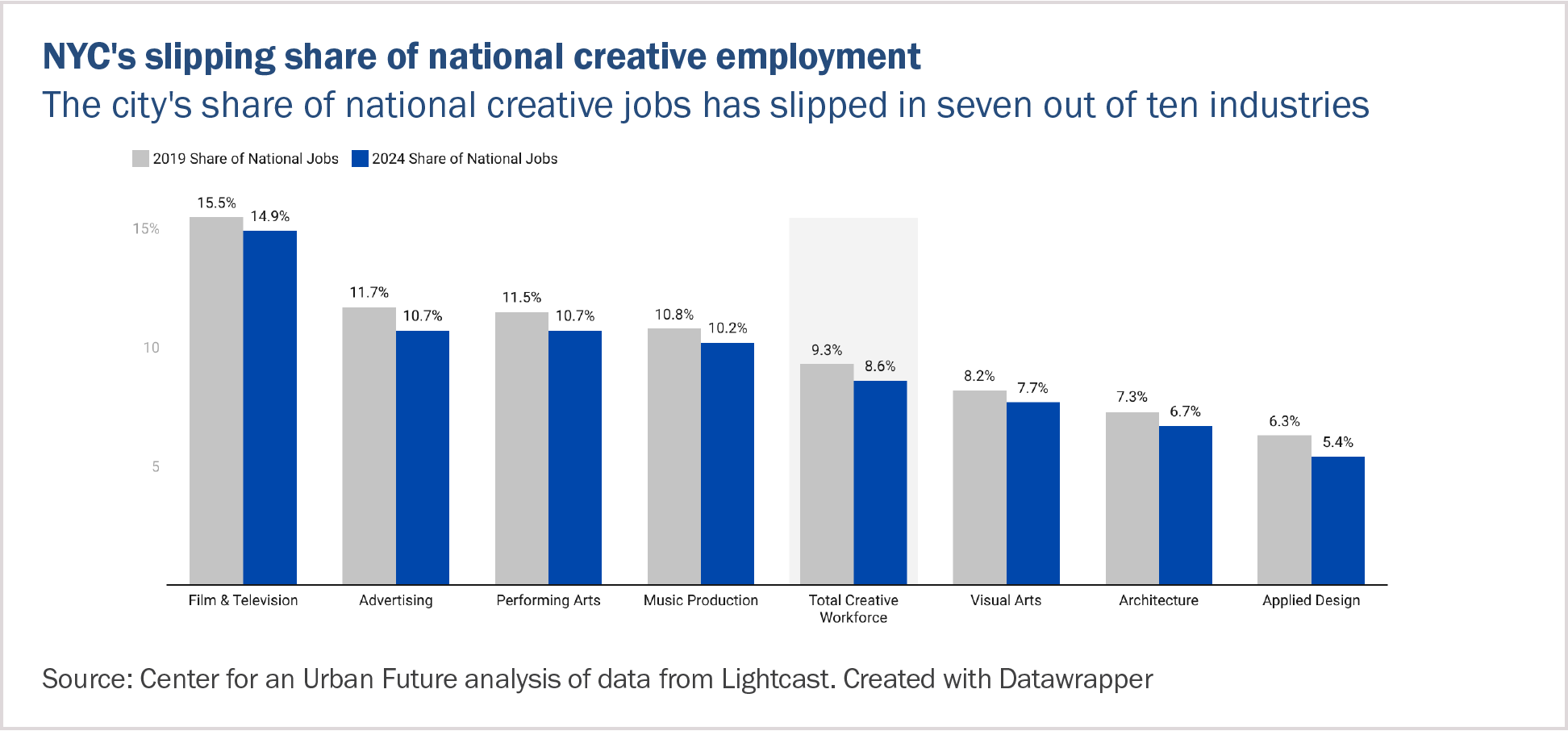
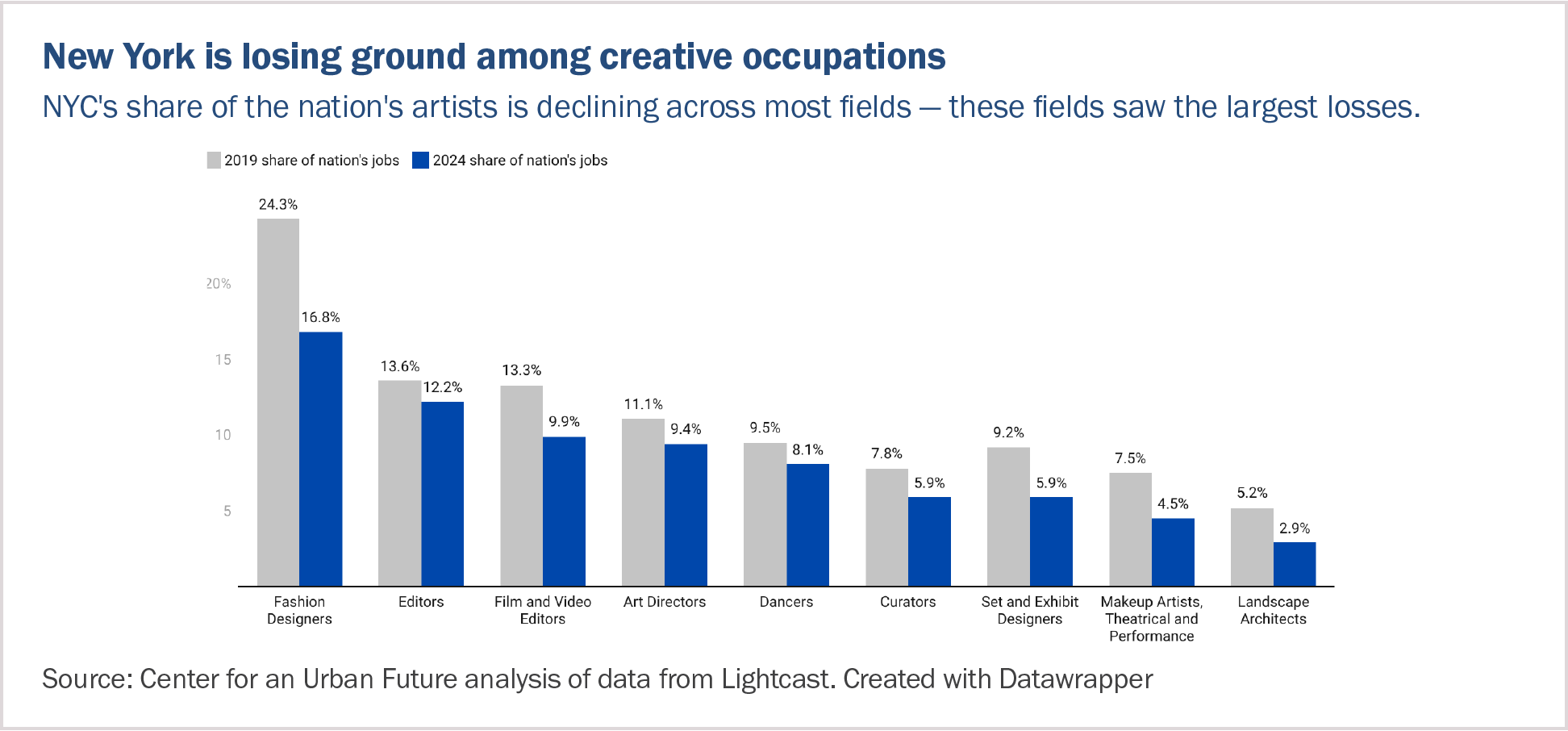
The city is also beginning to lose market share. New York City’s share of all people working nationwide in the creative economy has declined from 9.3 percent to 8.6 percent since 2019. There have been particularly worrisome declines in the city’s share of national employment in advertising (from 11.7 percent of the nation’s jobs in 2019 to 10.7 in 2024), performing arts (11.5 percent to 10.7 percent), applied design (6.3 percent to 5.4 percent), film and television (15.5 percent to 14.9 percent) and music production (10.8 percent to 10.2 percent). Behind the numbers, the city’s arts and culture ecosystem has sustained difficult losses.2 Many nonprofit arts organizations say they are more financially vulnerable than ever. And across the cultural landscape, venues are vanishing: Nearly 50 theaters, music clubs, museums, and galleries have shuttered since 2020, many pointing to lasting changes in audience behavior, soaring insurance costs, and other unsustainable operating pressures.
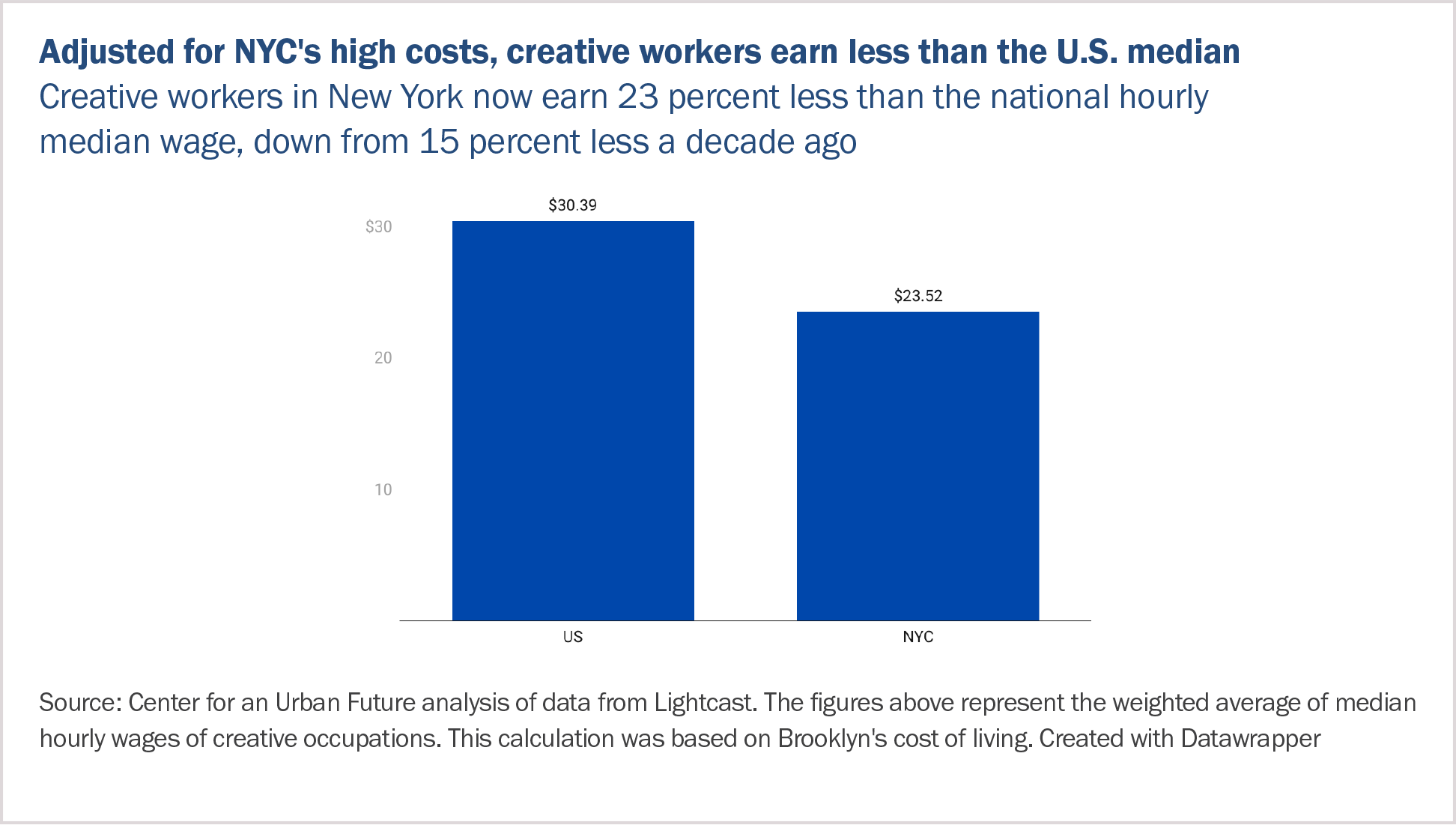
The causes run deeper than the pandemic. New York’s broader affordability crisis—already pushing out thousands of working- and middle-class residents—is hitting the creative sector especially hard. While artists have long struggled to afford life in New York, today those pressures extend across the entire creative economy, squeezing professionals in fields like advertising, design, and fashion. Creative workers in New York now earn about 23 percent less than the national average after adjusting for the city’s high cost of living, down from 15 percent less a decade ago, while housing and studio rents continue to climb.
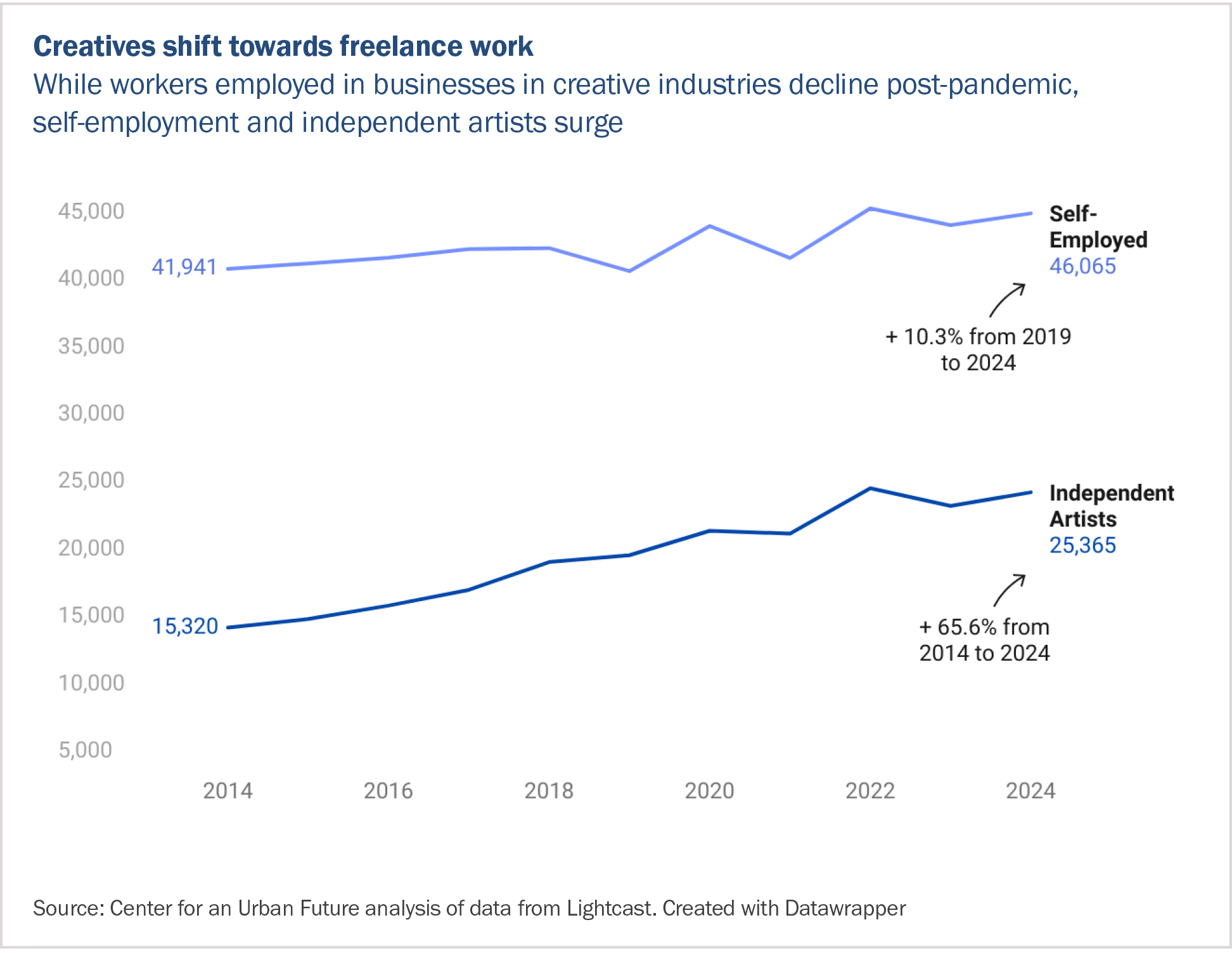
Nonprofit and commercial venues alike face rising expenses on every front—from labor and materials to insurance, which for many organizations has multiplied several-fold since 2020. While costs are up, many performing arts venues have seen notable declines in revenues from ticket sales, driven by major audience shifts since the pandemic—with people opting for in-home streaming over in-person attendance. At the same time, creative employment is shifting toward freelance and contract work: self-employment in creative industries has grown 10.3 percent since 2019, and the number of independent artists, writers, and performers is up 65.6 percent over the past decade, creating greater economic insecurity. Meanwhile, artists of color earn about 27 percent less than white artists, underscoring how existing inequities make the affordability crisis even more acute.3
Yet this is not a story of decline alone. Across the five boroughs, nightlife remains remarkably vibrant, museums are expanding, and new cultural spaces are taking root—from the Bronx Music Hall and ArtBuilt in Brooklyn to the reopening of the Studio Museum in Harlem. Over the past few years, New York City has made record investments in arts and culture, including the largest-ever budget for the Department of Cultural Affairs (DCLA) and new permanent baseline funding. The city has expanded the Cultural Institutions Group and launched initiatives like the City Artist Corps to support working artists.
But sustaining this progress will require going further. Even with public cultural funding at record highs, city leaders have done too little to tackle the structural pressures undermining the creative sector—especially the affordability crisis that is pushing artists and creative professionals out of New York. Today, the forces reshaping the creative sector extend well beyond arts funding. Housing and studio costs, insurance, the insecurity of freelance work, and the rise of AI demand a broader, cross-agency strategy—or New York risks losing the creative core that fuels its economy and identity.
The next administration will need to act boldly: dramatically expanding affordable artist housing and workspaces; stabilizing small venues by addressing skyrocketing operating costs; piloting portable benefits for freelancers; launching the city’s first annual five-borough cultural festival; and mobilizing agencies from housing, transportation, and parks to the Economic Development Corporation to fully integrate creativity into the city’s economic and civic agenda.
Two decades ago, the Center for an Urban Future published Creative New York, the first comprehensive report documenting the immense and growing economic and cultural impact of New York City’s artists, cultural organizations, and for-profit creative industries. This third landmark edition of Creative New York finds a vital sector at a defining crossroads: its importance to the city’s economy and civic life has never been greater, yet an intensifying affordability crisis has led to stagnant job growth, an exodus of artists, and a mounting challenge for the city’s next generation of leaders.
This report—supported by grants from the Rockefeller Brothers Fund, Howard Gilman Foundation, Ford Foundation, and Mellon Foundation—draws on more than 120 interviews with artists, cultural leaders, creative entrepreneurs, community-based organizations, business leaders, and policymakers across the five boroughs, as well as extensive analysis of employment, wage, and industry data from the U.S. Census Bureau, Bureau of Labor Statistics, New York State Department of Labor, Lightcast, and city, state, and federal budget documents.
Although much of this report details new challenges and threats facing artists, arts organizations, and creative industries, the central finding is a positive one: New York City boasts more cultural and creative jobs than any city in the United States, and this part of the economy—while often underappreciated—is more critical than ever to the city’s economic future. Overall, New York City’s broader creative sector—which we define to include 10 key industries: advertising, film and television, broadcasting and media streaming, publishing, architecture, design, music, visual arts, performing arts, and independent artists—employed 326,093 people in 2024 (including jobs in creative industries, creative jobs across the economy, and self-employment). That’s 6.1 percent below its 2019 peak, but up a remarkable 24.6 percent since 2004 and 3.5 percent since 2014.
The creative sector also provides New York with what is arguably its greatest competitive advantage. The city is home to 16.8 percent of the nation’s fashion designers, 15 percent of all producers and directors, and 12.2 percent of editors—far more than any other metro area. New York is home to more than 10 percent of national employment in film and television (14.9 percent), publishing (14.4 percent), broadcasting (12.7 percent), performing arts (10.7 percent), advertising (10.7 percent), and music production (10.2 percent). At the same time, creative nonprofits and businesses continue to put down roots here:creative firms accounted for 6.9 percent of all net new businesses formed over the past decade—more than in healthcare or education, and behind only technology and restaurants. The number of cultural nonprofits has also risen 32.1 percent since 2014, including an 18.9 percent increase since the pandemic, reaching a record 5,523 organizations.4 And New York is leading the globe in the emerging creator economy: the five boroughs are home to seven of the top 25 creators on Rolling Stone’s 2025 list—more than any other city.
The city’s unmatched cultural and creative ecosystem—powered by world-class institutions and thousands of small and mid-sized nonprofits with no parallel elsewhere—also anchors an immense tourism economy and serves as one of the most important draws for the talent that fuels industries from finance to tech. Indeed, the city’s unmatched creative edge may be the single most important asset that helps New York counteract the many negatives of living here, including the city’s astronomical cost of living.
But unlike in previous decades, New York is now losing share to cities across the country. Other regions—including many with significantly lower costs of living—have seen their creative workforces flourish since 2019, Nashville (+17.4 percent), Dallas (+14.3 percent), and Miami (+12.3 percent).5 Although New York City’s creative workforce is still larger than the combined totals for the Chicago, San Francisco, and Atlanta metro areas, the city’s share of national creative jobs has slipped in seven out of ten industries, including film and television, advertising, music production, performing arts, and applied design.
Likewise, artists are relocating in record numbers to more affordable cities and towns, while arts organizations—large and small alike—find themselves on increasingly shaky financial ground. These losses are reverberating across the city. And while New York remains the nation’s undisputed cultural capital, its creative foundation has rarely felt more fragile.
Or as Powerhouse Arts CEO Eric Shiner puts it, “If artists and creatives and actors and everyone else can’t afford to live here anymore, then the magic dies.”
The pandemic drove artists out—affordability is keeping them away
Affording life in New York has never been easy for artists. But since the pandemic, something fundamental has shifted. Work dried up, costs soared, and incomes failed to keep pace—pushing many artists past the breaking point and extending those same pressures across the broader creative economy.
Now, the affordability crisis that once hit hardest for early-career strivers is squeezing established artists and creative professionals alike. The result is visible across nearly every discipline, from dance and theater to design, film, and the visual arts: artists left during the pandemic, and many haven’t come back.
“We all know tons of artists that have moved upstate, moved out of the city, and don’t really have plans to come back,” says Lisa Gold, executive director of the Asian American Arts Alliance. “And it’s not just the artists—it’s the art handlers, the curators, the preparators. It’s a whole economy.”
Artist Kahlil Robert Irving, known for his tactile, immersive sculptures and installations, had gained national recognition through exhibitions at the Walker Art Center and the Museum of Modern Art (MoMA).
Yet by 2020, New York City had grown increasingly inhospitable, despite his rising success.
“Trying to survive and sustain in New York, the hustle gets complicated,” Irving says. “How much of yourself may you have to lose just to continue to participate?”
Ultimately, Irving chose to return to St. Louis, where his family lives. Freed from New York’s crushing costs, he was able to purchase a 13,000-square-foot warehouse studio—space and tools he could never have afforded in the city.
Irving is just one of thousands of artists who left New York since 2020 and have not returned. South Korea–born painter GaHee Park moved to Montreal in late 2020, citing diminished cultural vibrancy, the burden of renewing artist visas, and the appeal of more affordable studio and living space. Gregory Dolbashian, a New York–born dancer and choreographer, relocated his company, Dash Ensemble, to Dallas that same year, where he now runs a training program for young dancers. Even acclaimed novelist Zadie Smith left New York after more than a decade, returning to London in 2020.
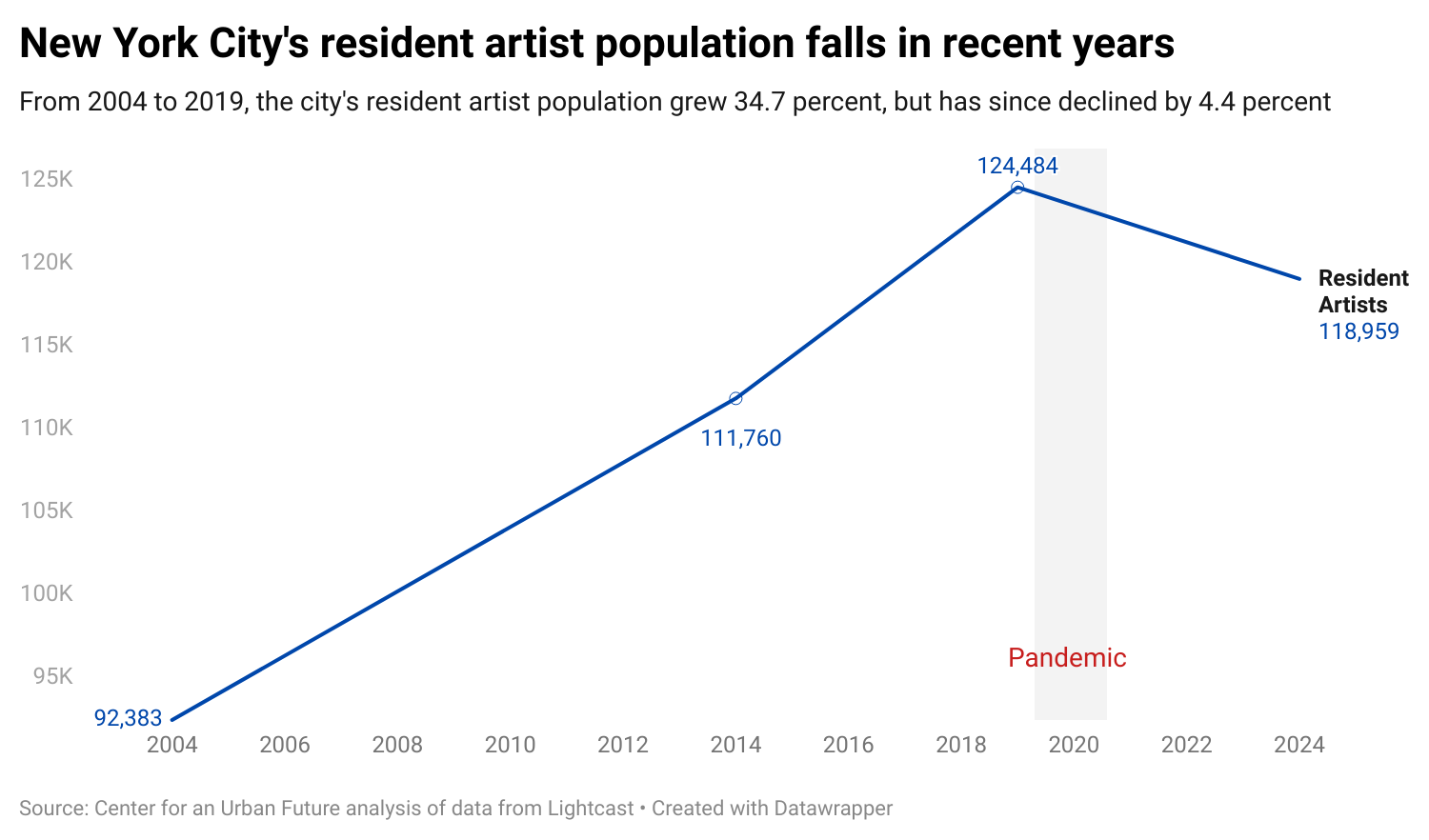
Many assume New York has been losing artists and creatives for decades, but resident worker data reveals the real decline began only in the past five years. Between 2004 and 2019, the city’s resident artist population increased by 34.7 percent—from 92,383 in 2004 to 111,760 in 2014 and 124,484 in 2019. But from 2019 to 2024, the city’s artist population has declined by 4.4 percent (to 118,959).
The pre- and post-pandemic shifts are even starker in several creative professions. The number of fashion designers living in the city rose 38.4 percent from 2004 to 2019, but has since fallen 25.9 percent.
Architects increased by 13.9 percent over the same fifteen-year span, but declined 4.6 percent from 2019 to 2024. The city’s editor population grew 41.6 percent from 2004 to 2019, then dropped 13.2 percent; and the number of art directors rose 28.8 percent before 2019 but has since fallen 6 percent.
Organizations are shedding jobs or simply shutting down
Since 2020, arts organizations across the city have closed their doors or scaled back operations, shedding jobs and audiences in the process. These closures are stark warnings that business and funding models
which sustained the arts for decades are faltering in a post-pandemic world. CUF’s research identified more than two dozen galleries that have shuttered in just the past two years, from stalwarts like Cheim & Read, Betty Cunningham, Jack Hanley Gallery, and Mitchell-Innes & Nash to younger spaces that championed emerging artists, including Deli Gallery, Fortnight Institute, Queer Thoughts, and DorDor.
Rising rents and uneven sales play a role, but gallerists also cite a deeper shift: the growing dominance of online sales and a diminishing need for physical space—changes with profound consequences for New York’s creative ecosystem. “The pandemic hit a lot of small- to medium-sized galleries, and the aftereffects hit even more,” says Eric Shiner of Powerhouse Arts. “So, a lot of smaller galleries are closing.”
It’s not just galleries. Small museums are buckling under economic pressures: Chelsea’s Rubin Museum of Art and SoHo’s Center for Italian Modern Art both closed in 2024, while museum employment overall is down 8.6 percent since 2019. Major institutions including The Guggenheim Museum and the Brooklyn Museum, have announced layoffs.6
Presenting organizations located in lower-income communities faced especially steep challenges during the pandemic. Fully 25 percent of arts groups in lower-income zip codes reported losing their sole physical space during the pandemic, compared to under 12 percent of organizations located in other areas.
Other pillars of New York City’s cultural infrastructure are beginning to fall as well. More than 20 music, performance, and nightlife venues have shuttered since the pandemic—including jazz clubs like Jazz Standard and 55 Bar, legendary drag venue Pyramid Club, and theaters such as The Secret Theatre and Playhouse 46.
Creative industry employment has declined since 2019
It’s not just nonprofit arts venues and institutions that are struggling. The fortunes of the city’s for-profit creative industries have taken a U-turn since the pandemic.
One key finding from the previous edition of Creative New York (2015) was that “several creative industries have been among the fastest growing segments of the city’s economy.” Indeed, employment in six different key creative industries outpaced the city’s 12 percent overall employment growth over the decade leading up to 2015—including film and television (growing by 53 percent over the prior decade), architecture (up by 33 percent), performing arts (26 percent), advertising (24 percent), visual arts (24 percent), and applied design (17 percent).
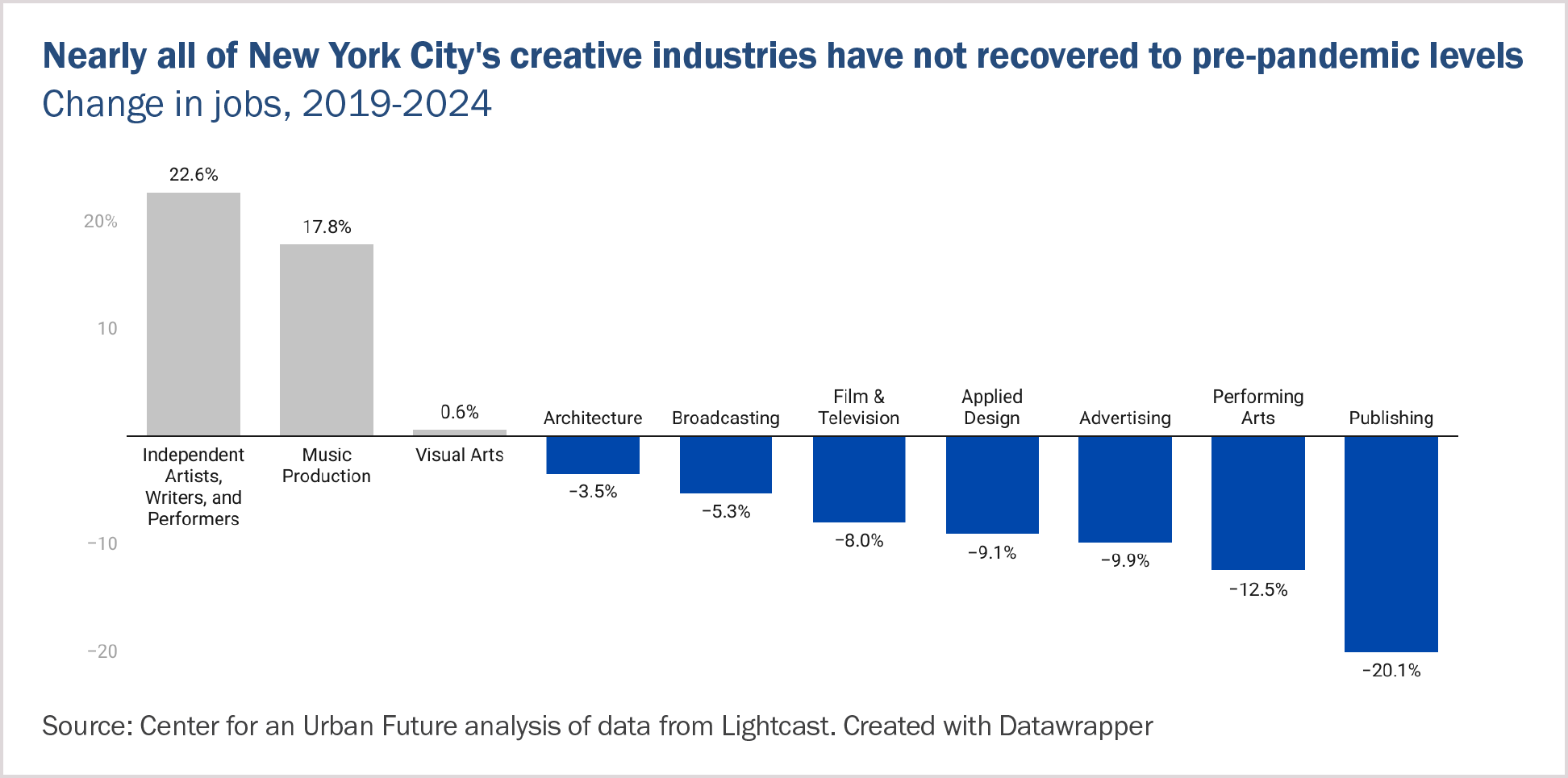
Most of these creative industries continued to add jobs at a brisk pace until 2020. But while the pandemic induced significant job losses in virtually every sector, employment in many creative industries has remained below pre-pandemic totals even as the city’s overall economy has more than recovered. From the first quarter of 2020 to the first quarter of 2025, total city employment is up 4.6 percent but down notably in film and TV (-19.1 percent), advertising (-15.7 percent), applied design (-14.3 percent), publishing (-11.7 percent), architecture (-9.4 percent), performing arts (-6.4 percent), music production (-3 percent), and visual arts (-1.3 percent).
These losses threaten what had been an encouraging development in the city’s economy: the emergence of a reliable new source of middle-class jobs. Behind the decline are major changes in how creative work is made and where it happens. The pandemic upended production models and accelerated a shift toward flexible, remote, and contract-based employment. As companies adapted to hybrid operations, many replaced full-time roles with freelance and project-based work. By 2025, just 45 percent of media workers report being in the office every day—the lowest share of any major industry. At the same time, companies have increasingly realized they can hire talent in other creative hubs—from Denver to Atlanta, and in cities around the world—where workers can plug into distributed teams and earn a good living at a fraction of a New York salary.
“It’s about how hard it is for young people in New York to live on salaries they earn in a lot of creative businesses,” says Andrew Robertson, chairman of BBDO Worldwide, a global creative agency headquartered in New York City. “These are cool jobs, but they don’t get paid a lot. At the same time, other cities are opening up as creative centers. If you were going into advertising ten years ago, you were going to New York, Chicago, Los Angeles, or San Francisco. That was kind of it. Now, you have the option of getting a good job in a decent agency in Atlanta, Austin, and other places. That’s a seismic shift that wasn’t there 10 years ago.”
It’s no coincidence that one of the only creative industries to grow since 2019 is independent artists, up 22.6 percent. That growth reflects the rise of freelance and self-employed creative workers—a shift that has brought greater flexibility but also deepened challenges around financial stability, health insurance, and other essential benefits.
Meanwhile, rising costs in New York are colliding with growing competition elsewhere. Cities like Atlanta, as well as international hubs such as London and Budapest, have become increasingly attractive for film and television production, offering lower costs, robust local talent, and strong public incentives. As New York’s affordability crisis worsens, more creative workers and companies are choosing to build careers and businesses elsewhere, or shift more of their buying and spending to other places.
New York’s arts ecosystem faces new and growing threats
New York’s arts ecosystem is inseparable from the city’s identity and essential to its civic life. It animates neighborhoods, brings people together across lines of difference, and strengthens local economies—from filling restaurants and hotels to supporting thousands of small creative businesses in every borough. But after years of mounting costs, uneven audiences, and intensifying competition, this ecosystem is under serious strain. Without new solutions, these challenges will erode not just the city’s cultural vitality but a key pillar of its civic and economic resilience.
The affordability crisis for artists has reached a breaking point.
New York’s affordability crisis has reached a breaking point for the city’s creative workforce. Even though creative economy workers here earn higher nominal wages than their peers elsewhere, after adjusting for the cost of living they earn about 22.6 percent less than the national average—a gap that has widened from 15 percent a decade ago.7 Meanwhile, asking rents have surged nearly 40 percent across Brooklyn, Queens, and the Bronx since 2019—forcing many artists to choose between housing and studio space.8
To afford market rents in the Bronx, residents would need to earn more than $120,000 a year, more than double the typical artist’s income. Neighborhoods that long anchored the city’s creative life are now losing artists at alarming rates. Since 2018, the artist population has fallen 5 percent in Bushwick, 17 percent in Harlem, and 18 percent in Chelsea and Hell’s Kitchen, as median asking rents have jumped more than 30 percent.9
Some neighborhoods have seen even steeper declines over the past decade: the artist population on the Upper West Side has fallen by nearly one-third, and on the Lower East Side it has plunged 55 percent while rents rose 46
percent. Meanwhile, over the past decade, U.S. cities have created more than 2,800 units of dedicated artist housing—with another 1,200 approved or under construction—and not a single one is in New York City.
At the same time, cities like Austin, Nashville, and Atlanta now offer something new: real opportunities in thriving creative sectors, paired with far lower costs of living. For many artists and creative professionals, that combination has become impossible to ignore— and New York is feeling the consequences. “We need New York to be a place that people want to come and build,” says Ben Lerer, managing partner of VC firm Lerer Hippeau. “The pain of living in New York needs to be outweighed by the value of community and the cultural richness of living here. It’s about safety and affordability, but also keeping the city interesting, fun, and cool, where diversity is celebrated.”
Audience habits have changed, and the pandemic recovery remains uneven.
Even before COVID-19, streaming and shifting leisure habits were reshaping how New Yorkers engage with culture. The pandemic dramatically accelerated those changes—and five years later, many organizations are
still feeling the effects. Broadway attendance has returned roughly to pre-pandemic levels, but other institutions continue to face volatility. The Guggenheim Museum welcomed 766,000 visitors in 2024—down one-third from 2019. And while the 39 members of the city’s Cultural Institutions Group saw record attendance in FY2024, overall visits still fell 9 percent last year, reflecting the broader instability that many organizations are experiencing.
At the same time, high ticket prices—often necessary to offset rising production and operating costs—are straining audiences as New Yorkers grapple with day-to-day affordability challenges. It’s not just Broadway or Madison Square Garden: at small venues in Bushwick or Greenpoint, a ticket to see a new band that cost $15 before the pandemic might now be $35, and an intimate off-Broadway performance can easily top $100. For many residents, live performance has shifted from a regular part of city life to an occasional luxury—with significant consequences for venues and presenting organizations of all sizes.
Costs for venues and organizations have gone through the roof—led by insurance.
It has always been hard to survive as an arts and culture organization in New York City, but today the costs of staying open are spiraling out of control. From insurance and wages to rent and utilities, expenses have surged since the pandemic. “New York is just so freaking expensive,” says Sade Lythcott, CEO of the National Black Theatre. “It’s more expensive to produce shows. It’s more expensive to retain staff. And the city in general—with inflation and cost of living increases across the board—is more expensive to live in.”
Insurance premiums, in particular, have become punishing. At Barbès, the beloved Brooklyn music venue, annual insurance costs have jumped from $4,000 to $22,000 over the past decade. Others have faced even steeper hikes: TBA Brooklyn, a now-closed Williamsburg club, saw its premiums soar from $25,000 to $125,000 before shutting its doors.10 New York’s high cost of insurance is driven in part by the city’s unusually high volume of lawsuits and liability claims. The Partnership for New York City reports that premiums here average about 15 percent higher than the national rate, with liability claim costs more than six times the U.S. average. Survey data shows that insurance has become the second-biggest cost concern for bars and restaurants—just behind labor—a challenge all too familiar to nightlife venues, concert halls, and other performance spaces.
Funding isn’t keeping up—and too often, it’s not arriving on time.
While costs are rising and revenues are down, public and philanthropic funding has not kept pace. The New York State Council on the Arts’ FY2025 budget for general operating grants—the most flexible and vital form of aid—is about $87 million, up from 2019 but still down 35.9 percent from its 1990 peak after adjusting for inflation. At the same time, New York City is home to a record 5,523 cultural nonprofits—up 32 percent over the past decade—meaning far more organizations are competing for a relatively flat pool of public and private dollars.
While the Department of Cultural Affairs has achieved historic gains, including a record $246.5 million in support for arts organizations and a permanent baseline increase, it still accounts for less than one-quarter of one percent of the city’s budget and cannot alone address the structural challenges reshaping the sector. Federal support is also eroding. The National Endowment for the Arts awarded $15.7 million to 446 New York City groups in 2024, but many have since lost funding as the Trump administration moves to dismantle arts and culture programs—continuing a 48.4 percent decline in federal arts funding to the region over the past 15 years.
Meanwhile, philanthropic priorities are shifting as major foundations redirect resources toward social services and shoring up the safety net in response to federal cuts. This shift has left the arts especially vulnerable—once again struggling to be seen as essential to the city’s well-being, even though the pandemic proved how vital culture is to recovery and resilience. “We are starting to see the erosion of foundation funding available to the arts, more drastically in the last two years,” says Lucy Sexton, executive director of New Yorkers for Culture and Arts.
Compounding these challenges, many arts nonprofits simply aren’t getting paid on time. While late payments to human services organizations have drawn long-overdue attention, arts organizations face the same problem—often with even less visibility. The city comptroller reports at least $1 billion in unpaid invoices across human services agencies, but that figure excludes the Department of Education, where many arts groups experience some of the longest delays, as well as the Department of Cultural Affairs, whose contracts are not included in those tallies.11 When payments are held up, smaller organizations that depend on city contracts are forced to take on debt, cut staff, or scale back programs just to stay open. “It’s really devastating to smaller groups,” says Risa Shoup, co–executive director of the Alliance of Resident Theatres/New York. “They rely disproportionately on public funding because they don’t meet the threshold for private philanthropic support—and they need those contracts to come through quickly.”
Federal threats and culture-war politics are adding new uncertainty.
After weathering the pandemic, New York’s arts and creative sector now faces new threats from Washington. The Trump administration has begun slashing federal funding for arts and culture, putting at risk a vital source of support for hundreds of city institutions. The National Endowment for the Arts (NEA) has already pulled grants from organizations including the Classical Theatre of Harlem ($60,000) and the Trisha Brown Dance Company ($40,000).12 These cuts are the latest in a decade-long decline in federal arts funding, and the entire NEA budget is now under threat.
At the same time, a new federal policy requiring NEA applicants to be reviewed for compliance with the president’s executive order on so-called “gender ideology” poses specific risks for LGBTQ+ arts organizations
and raises broader concerns about free speech and artistic expression (though a recent federal court ruling found the restriction unconstitutional, a decision the government could still appeal). At the same time, a new federal policy requiring NEA applicants to be reviewed for compliance with the president’s executive order on so-called “gender ideology” poses specific risks for LGBTQ+ arts organizations and raises broader concerns about free speech and artistic expression. And the impact extends beyond funding: federal actions have dampened international tourism, including a sharp drop in visitors from Canada—one of New York’s largest tourist markets—and made it harder for foreign artists to secure visas or feel safe traveling to the U.S.13
Together, these developments threaten not only the city’s arts institutions but the broader creative economy that depends on cultural exchange and global engagement.
New York City’s creative industries are also at risk New York’s for-profit creative sectors—film and television, advertising, design, fashion, architecture, and more—have been hit hard by pandemic-era disruptions and are now grappling with deeper structural shifts. While jobs have partly rebounded, many industries remain under severe strain as costs rise, technologies evolve, and competition intensifies.
Rising costs are squeezing firms at every level—but the biggest pressure point is people.
The cost of hiring and retaining creative talent has soared as rents, childcare, and everyday expenses make it harder for workers to stay in New York, even on solid salaries. Employers say they are losing mid-career staff to more affordable markets, from Atlanta and Denver to Philadelphia and Austin, while rising compensation expectations make it difficult to expand payrolls or invest in new projects. Facing both higher labor costs and clients demanding leaner budgets, many firms are rethinking where they hire—and where they grow.
Technological change is transforming the landscape.
Automation and AI tools are upending traditional creative roles, particularly in advertising and design, where influencer-driven content and algorithmic branding have replaced many labor-intensive campaigns. Streaming has also reshaped film and television, reducing the number of large-scale productions that once anchored local crews.
Global and domestic competition is intensifying.
Cities like Atlanta, Austin, and Los Angeles are investing heavily in creative infrastructure, offering tax incentives and lower costs to lure production. Internationally, Seoul, Shanghai, and Copenhagen have emerged as new fashion powerhouses, while Toronto, Vancouver, Budapest, and Prague are booming as production hubs. New York’s creative dominance is no longer guaranteed.
Nowhere are the stakes higher than in the rise of artificial intelligence.
No city is more exposed to AI’s impact on creative work than New York, home to both the nation’s largest concentration of artists and a rapidly growing AI sector. Generative AI is cutting costs but also threatening jobs as companies automate tasks once handled by writers, designers, and musicians. Yet it is also fueling new creative frontiers—from Marc da Costa’s interactive installation The Golden Key at the Brooklyn Academy of Music (BAM) to Eunsu Kang’s AI-driven visual experiments and exhibitions at the Museum of Modern Art (MoMA), the Guggenheim, and the Whitney Museum of American Art. The challenge for New York is to ensure that these breakthroughs spark new creative possibilities rather than hollow out the city’s creative middle class.
Renewing New York City’s creative spark
New York’s creative sector stands at a crossroads. Without bold, coordinated action, the city risks losing the artists, organizations, and creative businesses that help power its economy and define its identity. To realize this vision, city and state policymakers will need to go further—integrating the arts into economic development, transportation, and public space initiatives. That means expanding creative placemaking through New York City Department of Transportation (NYC DOT) plazas, growing public art partnerships with Parks, ensuring affordable arts spaces through New York City Economic Development Corporation (NYCEDC) projects, resourcing the promising Create in Place program, and fully implementing the city’s Percent for Art law across its vast capital program.
This report lays out a series of recommendations to help artists not just survive but thrive in New York City over the next decade. To do so, city government should invest in and build deeply needed housing to improve overall affordability, while integrating an artist preference into affordable housing programs. It should partner with nonprofits to raise wages for arts workers, expand access to health coverage, and pilot portable benefits for freelancers and independent artists.
At the same time, the city should launch a pooled insurance program to help small cultural venues and nonprofit theaters manage soaring costs, while directing agencies beyond DCLA—including NYCEDC, NYC DOT, NYC Parks, and Small Business Services—to fully integrate the arts into their economic development, transportation, and public space work. Finally, New York should launch the city’s first-ever five-borough cultural festival to celebrate local talent, while expanding public art and cultural programming in schools, libraries, parks, subway stations, and senior centers.
Together, these actions would move New York beyond recovery—toward a stronger, more equitable creative future in which artists, cultural organizations, and creative businesses are recognized not as amenities, but as essential infrastructure for the city’s continued vitality.
Continue reading the full Creative New York report here.
Without bold, coordinated action from city and state policymakers, the city risks losing the artists, organizations, and creative businesses that help power its economy and define its identity. The following series of recommendations will ensure artists not just survive but thrive in New York City over the next decade:
1. Make New York more affordable—for artists and everyone. The single most effective step city and state leaders can take to sustain New York’s creative sector is to tackle the affordability crisis head-on. Soaring housing costs have made it nearly impossible for many artists and creative professionals to live and work here. Reversing this trend will require a massive increase in housing production citywide—including deeply affordable, workforce, and middle-income units—paired with reforms to unlock more supply in every borough. The City of Yes for Housing Opportunity is an important step forward, but far more will be needed to meaningfully expand the city’s housing supply. Policymakers should build on City of Yes by extending as-of-right zoning to more transit-rich areas, fully eliminating remaining parking minimums, streamlining permitting and environmental review processes that continue to delay projects, legalizing accessory dwellings more broadly across low-rise neighborhoods, expanding opportunities for small-site and missing-middle infill, establishing a viable financing framework to support new rental housing production, and strengthening preservation tools to stabilize the city’s existing affordable housing stock. Without these changes, ambitious new housing targets will fall short—and New York risks losing the creative core that powers its economy and civic life.
2. Create 5,000 artist-preference housing units by 2030. New York City has fallen behind the rest of the state—and the nation—when it comes to developing affordable housing for artists. To reverse this, the city should commit to building or designating 5,000 artist-preference units by 2030, achieved through modest set-asides in citywide affordable housing projects, prioritized on public land and in mixed-income developments. HPD should issue clear guidance on artist-preference policy modeled on state standards to ensure equitable, transparent implementation. The city should also create a biennial NYC Artist Survey and dashboard to collect better data on artists’ housing and space needs. In parallel, policymakers should develop a citywide “Artist Live/Work Standard” that establishes zoning and code models for safe, practical mixed-use housing. Artist-preference units should also be incorporated into office-to-residential conversions, and a new Artist Housing Accelerator should help fund early-stage costs for projects serving this vital but vulnerable workforce.
3. Launch NYC’s first five-borough cultural festival. New York is home to a rich array of annual cultural events—from Lunar New Year celebrations and the West Indian Day Parade to the Tribeca Film Festival and the Armory Show. But the city still lacks a signature, citywide festival on the scale of Austin’s SXSW, the Venice Biennale, or the Edinburgh Fringe, which generates more than 3 million ticket sales and $630 million in economic impact for a much smaller city. A Five Borough Cultural Festival—coordinated by the city and designed to build on and amplify the many festivals and programs already happening throughout the year—would give residents and visitors a powerful new reason to explore the city’s creative landscape.
With strong mayoral leadership, the festival would enlist hundreds of venues and organizations across all five boroughs and open streets, plazas, parks, historic buildings, and city-owned properties for music, dance, theater, visual art, open studios, and immersive experiences—while significantly easing red tape for outdoor cultural programming. The first iteration need not be prohibitively complex; simply identifying a week in the calendar, rallying existing partners, and putting the mayor’s support behind a unified cultural moment could go a long way toward making this a reality. Over time, sponsorships, ticketed events, and festival passes could offset much of the cost, while the city focuses on coordination, access to public space, streamlined permitting, and resilience planning.
4. Launch a portable benefits pilot for freelancers and self-employed artists. Nearly one-third of New York’s creative workers are freelancers, independent contractors, or self-employed—and they’re part of a rapidly growing independent workforce citywide. Yet most lack access to the basic safety nets that full-time employees rely on: health insurance subsidies, paid leave, retirement savings, and unemployment support. To make creative work more sustainable and address deep inequities facing creative workers of color, the next mayor should launch a portable benefits system that allows independent workers to accrue and keep essential benefits as they move between gigs, employers, or sectors. Rather than building a new public agency, the city should partner with a trusted nonprofit like Freelancers Union to administer portable accounts, with proportional contributions from employers, platforms, and public funding.
A streamlined, universally accessible portable benefits system would reduce economic precarity across the arts while strengthening the broader freelance and gig workforce. Benefits should follow the worker—not the job—and include options such as health-insurance subsidies, paid leave, and retirement savings. By pooling contributions and simplifying enrollment, New York can ensure that independent workers receive meaningful, durable support without adding administrative burdens. This approach would help stabilize creative careers, boost equity, and keep more artists and freelancers in the city for the long term.
5. Establish a pooled insurance program for venues and cultural nonprofits. Insurance costs have become one of the most punishing—and destabilizing—expenses facing New York City’s arts organizations and small venues, with premiums doubling or tripling since the pandemic. To prevent further closures, the next mayor should launch a city-facilitated pooled insurance program that allows cultural organizations to access affordable coverage through collective purchasing power. The city should partner with NYCEDC or SBS and a trusted nonprofit intermediary to negotiate discounted group rates for liability, property, event, and venue insurance, with additional subsidies for organizations under $1 million in annual revenue.
The pooled program could function similarly to group health purchasing alliances: organizations join voluntarily, the city helps secure better prices and stronger underwriting, and a nonprofit administrator handles enrollment and compliance. Over time, the city should commission a feasibility study on establishing a captive insurance entity or risk retention mechanism specifically for the arts and nightlife sector—creating a long-term, self-sustaining solution. In the near term, however, a collective purchasing pool would provide immediate relief, freeing up scarce organizational dollars for programming, staff, and community engagement—and helping small venues survive in every borough.
6. Help cultural organizations build long-term stability and increase flexibility. For many small and mid-sized arts organizations, the rising cost of space has become a fundamental barrier to stability. While ownership is not the right solution for every group—particularly those without the balance sheet, staffing capacity, or financial cushion to manage a building—preserving existing cultural spaces and supporting the subset of organizations that are prepared to take on ownership can be essential to ensuring long-term community cultural assets. The city and state should launch a Cultural Ownership Fund focused on helping mission-driven cultural organizations retain space already in the sector and supporting those with the capacity to responsibly acquire or co-locate in permanent homes, with priority for groups rooted in lower-income communities.
At the same time, any ownership strategy must be paired with policies that help organizations keep their operations strong and adaptable. This includes scaling shared back-office services—such as accounting, payroll, HR, and benefits—by expanding cooperative models like ArtsPool, and supporting shared-space arrangements that allow multiple organizations to co-locate, program jointly, or share rehearsal, performance, and fabrication facilities. Flexibility is just as important as stability, which is why the city should also reform its overly cumbersome Temporary Place of Assembly permitting process so that arts and culture producers can more easily activate
unused spaces for performances, exhibitions, and concerts.
7. Scale up NYCEDC’s support for the creative economy. NYCEDC already plays a role in supporting the city’s creative economy, but its focus and resources remain far smaller than those devoted to sectors like life sciences, green tech, or manufacturing. To meet the scale of the challenge, NYCEDC should elevate and expand its Creative Industries work into a core pillar of the agency’s economic strategy, on par with other growth sectors. That means dedicating new staff and funding to coordinate investments across design, advertising, music, fashion, and film; embedding creative industry goals in every NYCEDC capital project; and integrating creative workforce development into the agency’s training and entrepreneurship programs.
NYCEDC should commit to dedicating at least 1 percent of capital budgets to public art or creative placemaking in every capital project—building on the existing Percent for Art law but applying it more consistently and intentionally across EDC-managed developments. By involving artists much earlier in the design process, EDC can move beyond end-stage murals or sculptures and integrate creative elements from the start, from outdoor performance spaces to artist work areas or artist-designed architectural features, ensuring capital investments strengthen the city’s cultural vitality. The agency should also expand shared production hubs for music, podcasting, and small creative businesses and launch signature initiatives such as Independent Film Week and a global NYC Music Summit to cement the city’s standing as a creative capital. At the same time, NYCEDC should partner with industry leaders to stabilize struggling sectors—including advertising, design, and film—through business incubators, export assistance, and targeted workspace incentives
8. Embed artists across city government. New York’s Public Artists in Residence (PAIR) program has already shown the power of integrating artists into city agencies—but its reach remains limited, touching only a small share of the government. The next mayor should expand PAIR tenfold and create full-time civic artist positions embedded within high-impact agencies such as Housing Preservation and Development (HPD), Transportation (DOT), Youth and Community Development (DYCD), City Planning (DCP), and Buildings (DOB)—none of which have ever hosted a PAIR artist, despite their central role in shaping daily life. Each agency should develop a “+Art” initiative—DOT + Art, Parks + Art, Hospitals + Art—pairing artists with public servants to co-design creative projects, community engagement campaigns, and civic improvements.
These collaborations can transform everyday infrastructure into platforms for expression, from installations in civic buildings to youth engagement programs, public-space activations, and community-building cultural events. Embedding artists across these agencies would strengthen trust between residents and government, make civic spaces more welcoming, and help address complex challenges with new creative tools. Expanding PAIR beyond the handful of agencies that have participated to date would signal that creativity is a core city function—not an afterthought—and weave the arts more fully into urban problem-solving.
9. Generate dedicated, recurring revenue for the arts. Even with steadily increasing cultural budgets, the city’s arts ecosystem remains vulnerable to fiscal swings—including federal funding cuts—even as the number of cultural nonprofits has surged over the past decade. To improve stability, policymakers should establish recurring revenue streams dedicated to arts and culture. One approach is a voluntary surcharge on overnight hotel stays with proceeds directed to a “Parks and Culture Fund” supporting both public art and recreation. The city could also pilot designated Cultural Districts, funded through modest assessments on nearby property owners, to sustain programming and maintenance in key cultural corridors. Together, these mechanisms would ensure predictable funding for the arts while aligning investment with the tourism, development, and quality-of-life benefits that culture generates citywide.
In addition to generating new revenue, the city should make its existing public funding more reliable and equitable. The mayor should prioritize reforms to the Department of Cultural Affairs’ Cultural Development Fund to ensure timely payments, transparent reporting, and more stable multiyear operating support for midsized cultural organizations. Establishing a new tier of “Cultural Organizations Group” grantees—between the major Cultural Institutions Group and smaller nonprofits—would provide predictable funding to hundreds of midsized organizations that anchor local creative ecosystems but currently face chronic instability.
10. Launch a Creative Pathways and Talent Pipeline Initiative across NYC public schools and CUNY. New York City’s creative economy does not reflect the diversity of the city—and without deliberate action, those inequities will remain. To ensure that far more New Yorkers can access the well-paying careers in design, film and TV, advertising, creative tech, performing arts, and cultural management, city leaders should launch a Creative Pathways and Talent Pipeline Initiative spanning NYC Public Schools and CUNY. At the K–12 level, the next administration should make the creative economy the next major focus of FutureReadyNYC, building on the initiative’s progress in business, technology, healthcare, and education. This should include establishing Creative Schools NYC, a new effort to guarantee meaningful, sequential arts and creative-skills learning in every grade band; expanding highly effective but small-scale nonprofit programs; integrating creative occupations into the city’s youth apprenticeship efforts; and increasing creative-sector participation in the Summer Youth Employment Program. A centralized employer-matching effort—guided by a new creative-sector advisory council—would help ensure that work-based learning opportunities reach far more schools and students. At the postsecondary and early-career level, the city should establish a Creative Economy Talent Pipeline that connects CUNY students and adult learners with paid internships, mentorship, and clear routes into a full range of creative careers—building on and going beyond the CUNY Cultural Corps, which is exclusively focused on nonprofit arts. This effort should replicate the success of CUNY 2X Tech through a CUNY 2X Creative initiative, designed to bring career exploration, mentorship, and industry expertise to CUNY students interested in creative careers.
Continue reading the full report here.
Endnotes
1. Center for an Urban Future. Analysis of Data from Lightcast, using the “Resident Worker” metric. Accessed October 17, 2025.
2. Claire Cain Miller and Francesca Paris, “Why Americans Are Becoming Homebodies,” New York Times, October 5, 2024, https://www.nytimes.com/2024/10/05/upshot/americans-homebodies-alone-census.html.
3. Center for an Urban Future. Analysis of Data from the 2023 American Community Survey 5-Year Estimates, defining artists as “SOC 27-1010 Artists and Related Workers, SOC 27-2010 Actors, Producers, and Directors, SOC 27-2030 Dancers and Choreographers, SOC 27-2040 Musicians, Singers, and Related Workers, SOC 27-2091 Disc Jockeys, Except Radio, and SOC 27-3040 Writers and Editors, SOC 27-4021 Photographers.”
4. Urban Institute, National Center for Charitable Statistics (NCCS). “Nonprofit Sector in Brief Dashboard.” http://nccsweb.
5. Center for an Urban Future. Analysis of Data from Lightcast. Other cities are defined through their MSA boundaries.
6. Robin Pogrebin, “Guggenheim Museum Lays Off Workers Amid Financial Strain,” New York Times, February 28, 2025, https://www.nytimes.com/2025/02/28/arts/design/guggenheim-layoffs.html; Robin Pogrebin, “Brooklyn Museum Lays Off Dozens of Employees,” New York Times, February 7, 2025, https://www.nytimes.com/2025/02/07/arts/design/brooklyn-museum-layoffs.html.
7. Center for an Urban Future. Cost of living adjustments use the COL index from Lightcast, which comes annually from C2ER, adjusted to Brooklyn’s cost of living.
8. Jiayi Xu and Danielle Hale, New York City Rental Report 2025 Q1: The Pricey Get Pricier—All New York City Boroughs Experienced Year-Over-Year Rent Growth (2025), https://www.realtor.com/research/nyc-q1-2025-Rent/.
9. Center for an Urban Future. Analysis of Data from the 2023 American Community Survey 5-Year Estimates, defining artists as “SOC 27-1010 Artists and Related Workers, SOC 27-2010 Actors, Producers, and Directors, SOC 27-2030 Dancers and Choreographers, SOC 27-2040 Musicians, Singers, and Related Workers, SOC 27-2091 Disc Jockeys, Except Radio, and SOC 27-3040 Writers and Editors, SOC 27-4021 Photographers.”
10. Nate Schweber, “Brooklyn Nightlife Faces Wave of Closures,” New York Times, April 8, 2025, https://www.nytimes.com/2025/04/08/realestate/brooklyn-closures-nightlife.html.
11. Office of the New York City Comptroller. Nonprofit Nonpayment Report. https://comptroller.nyc.gov/reports/nonprofit-nonpayment/.
12. Ben Yakas, “NYC Cultural Institutions Scrambling after Trump Admin Guts Arts Funding,” Gothamist, https://gothamist.com/arts-entertainment/nyc-cultural-institutions-scrambling-after-trump-admin-guts-arts-funding.
13. Julie Watson, “U.S. Detention of European and Canadian Tourists Creates Fear over Traveling to America,” PBS NewsHour, March 21, 2025, https://www.pbs.org/newshour/world/u-s-detention-of-european-and-canadian-tourists-creates-fear-over-traveling-to-america; Nia Decaille, “Hoping to Visit the U.S.? It Might Cost You an Extra $250,” New York Times, July 22, 2025, https://www.nytimes.com/2025/07/22/travel/visa-integrity-fee-trump-big-beautiful-bill.html.