Mayor Zohran Mamdani begins his term with an ambitious agenda aimed at making New York City more affordable. But paying for these bold new initiatives while sustaining core services and programs will be challenging at a time when the city and state face widening budget gaps and massive cuts in federal funding. As the mayor himself put it in response to Governor Kathy Hochul’s State of the State address, “There is no question that New York City requires additional recurring revenue.”
The mayor has already floated ideas, including a proposal to raise taxes on high earners and corporations. But given that this and other ideas require approval from Albany—and that Governor Hochul has ruled out tax increases—city leaders would be wise to consider multiple new options for generating dedicated revenue, especially those that are firmly within the city’s control.
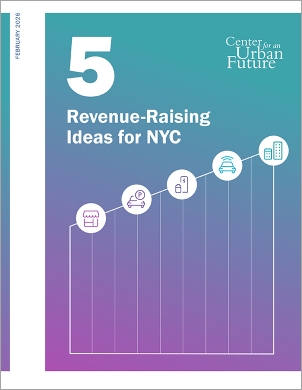
This report does just that. It puts forward five concrete ideas to generate new recurring revenue for the city. Taken together, our five ideas would raise more than $1.4 billion in new revenue each year—or $5.6 billion over the next four years. Importantly, each revenue idea would also advance other critical policy goals at the same time.
There’s no question that new revenues are needed. Mayor Mamdani is inheriting a city budget marked by persistent structural gaps and little room for creative reallocation. Most of the city’s spending is already locked into fixed cost categories such as employee compensation, education, healthcare, and social services. In recent years, the city has spent billions more than it has collected, while underbudgeting current and future expenses.1 And the risks only grow if and when the next economic downturn hits, with just $2 billion saved in the city’s Rainy Day Fund.2
Despite better-than-expected revenues in fiscal year 2025, the city’s fiscal outlook remains precarious. The City Comptroller projects a $4.2 billion budget gap in FY 2026, and city and state officials estimate that the gap could widen to $10 billion by FY 2027 and $13.6 billion in FY 2029.
Compounding these challenges are federal policy changes under the Trump administration that are expected to place massive new strains on the city’s budget. Federal cuts to Medicaid and SNAP will add an estimated $952 million to New York State’s FY 2026 expenditures, and billions more in the years ahead—much of which could ultimately be borne by the city.
Raising new revenue should not be the city’s only response to this budget predicament. The new administration will also need to be laser-focused on boosting efficiency, spending city dollars wisely, and ensuring that public programs generate the maximum possible impact. That includes cutting red tape that inhibits entrepreneurship, small business growth, and housing production, as well as investing in proven economic opportunity and social mobility programs that expand pathways into the middle class and strengthen the city’s economic foundation. But even a more disciplined approach to spending will not be sufficient on its own. Navigating the challenges ahead will also require new, dedicated sources of revenue.
This report presents five practical options that city leaders should consider as part of the FY 2027 budget. The proposals include levying an impact fee on autonomous vehicles; opening public land for battery storage to strengthen the energy grid; expanding paid street parking; producing new housing on CUNY campuses; and expanding parks concessions and sponsorship opportunities to help fund quality open spaces. Together, these ideas are designed to boost housing supply while funding economic mobility; reduce traffic, crashes, and emissions; and position New York City to succeed as new technologies mature.
As these initiatives scale over the next four years, they could generate approximately $5.6 billion in cumulative revenue. Over the longer term, the proposals for CUNY infill housing and city-sited battery storage could generate more than $5 billion in total lease revenue, a portion of which could be leveraged to support approximately $400 million to $700 million in bond financing for critical capital investments. Together, these revenues would help shore up the city’s finances at a moment when New York will need to protect vital services, expand opportunity, and keep the city strong for working- and middle-class New Yorkers during a uniquely challenging time.
Our five ideas include:
1. Develop infill housing on portions of CUNY’s campuses to fund critical infrastructure and economic mobility programs.
2. Generate revenue from autonomous vehicles by establishing impact fees before the market grows.
3. Generate revenue and strengthen the energy grid by siting battery storage facilities on city property.
4. Expand paid street parking, adding more parking meters and piloting new paid street parking options.
5. Expand parks concessions and sponsorship opportunities to help fund quality open spaces.
Read the full report and all five ideas here.
Endnotes
1. Chris Henrichson and Ana Champeny, NYC Budget Blueprint: 9 Smart Choices to Improve Stability, Preparedness, and Services, Citizens Budget Commission, November 2025, https://cbcny.org/sites/default/files/media/files/CBCREPORT_SmartChoices-Blueprint_11122025_0.pdf.
2. Office of the New York State Comptroller, Review of the Financial Plan of the City of New York, Report 18–2026, December 2025, https://www.osc.ny.gov/files/reports/osdc/pdf/report-18-2026.pdf.