Testimony of John Surico
Senior Fellow for Climate and Opportunity, Center for an Urban Future
Before the New York City Council Committee on Parks and Recreation
Budget and Oversight Hearing on the Preliminary Budget for FY 2027
March 23rd, 2026
Good afternoon. I’m John Surico, the Senior Fellow for Climate and Opportunity at the Center for an Urban Future, an independent think tank focused on creating a stronger and more inclusive economy in New York. Thank you to Chair Hankerson and members of the committee for the opportunity to testify today.
Thriving parks and open spaces are essential to achieving the city’s vision of an affordable, livable New York. But today, the system is struggling under the weight of four consecutive years of budget cuts—and lacks the maintenance funding and staffing needed to sustain the vibrant, equitable parks system that New Yorkers need and deserve.
Case in point: recreation. The city’s athletic facilities and recreational programs—its pools, tennis courts, rec centers, fitness classes, sports leagues, and more—play an integral role in offering free and low-cost options for New Yorkers to move, play, and connect. That matters today more than ever, as over 40 percent of residents are grappling with chronic disease and loneliness, and more than half are overweight or obese. But decades of underinvestment mean we’re only scratching the surface of its potential.
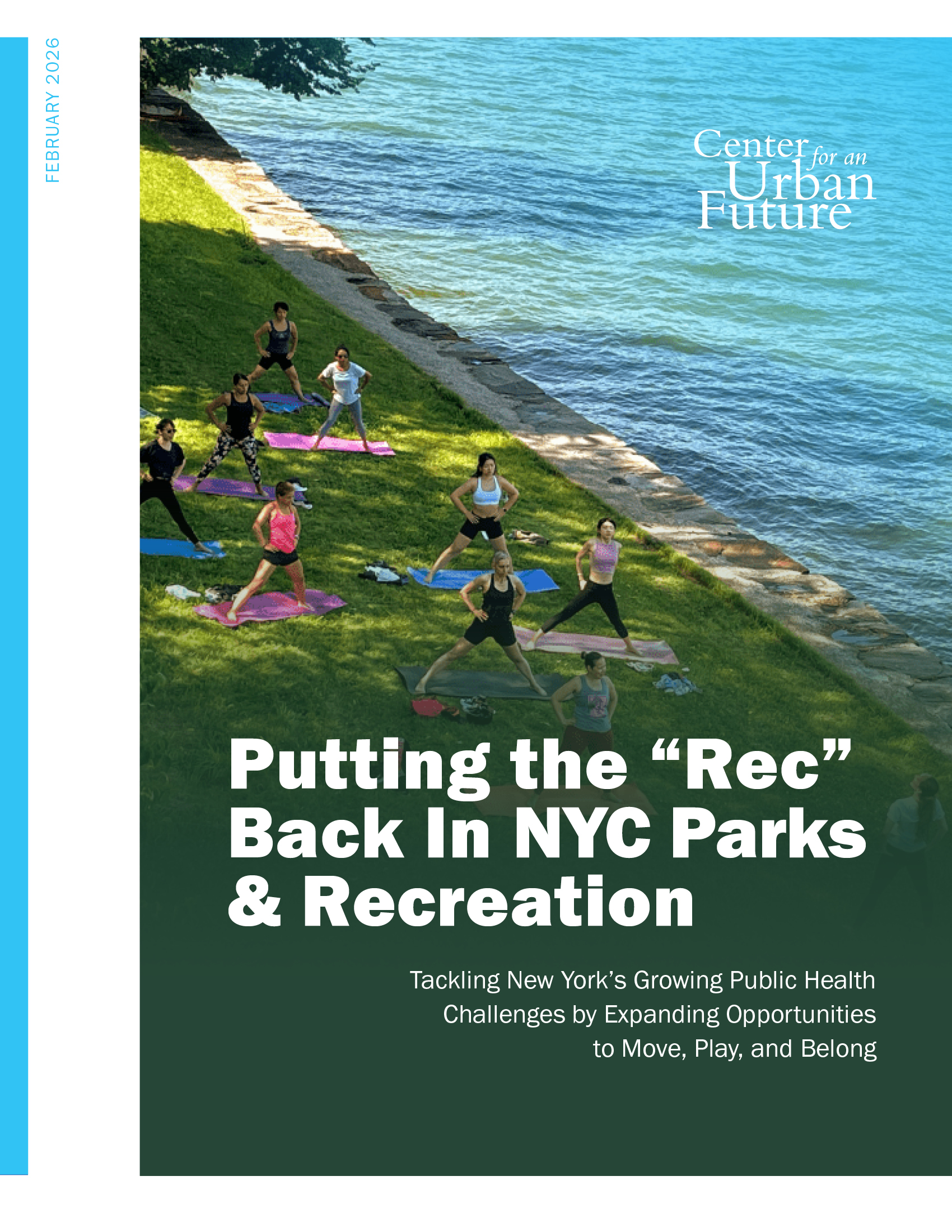
Our recent report found that recreation services once accounted for nearly one-third of NYC Parks’ operating budget; today it represents around 5.3 percent. Full-time recreation staff has fallen from almost 2,000 in 1964 to 659 today. New York allocates among the lowest amount per capita on recreation of any major U.S. city. And many core recreation assets need urgent repairs or are closed entirely, with more than $400 million in known capital needs for major facilities alone, and likely hundreds of millions more yet to be identified.
NYC Parks continues to do what it can with limited resources, but the gap between needs and capacity keeps widening. Going forward, the city should restore and expand critical staffing across parks operations, capital projects, forestry, and maintenance—while investing in recreation centers and program staff—to get parks clean, safe, and fully functional again. For instance, these investments could help address New York City’s affordability challenges by expanding the parks system’s summer day camp program—the best deal anywhere in the city—from roughly 500 participants today to 5,000.
To achieve this, the City Council should reverse the proposed cuts and expand city funding—but also create new, dedicated recurring revenue streams to put the system on stronger, more sustainable footing. In January of 2024, the Center outlined 20 specific, achievable ideas to do exactly that. And last year, we published briefs for two ideas in particular—a modest surcharge on tickets sold at stadiums located on parkland, and expanding parks concessions—laying out the steps needed to get them done. In the coming months, we’ll release two more: the first on harnessing real estate revenue to pay for parks care, and the next on expanding opportunities for public-private partnerships.
Money earned in parks should stay in parks—and the fact that it doesn’t is a real ‘only in New York’ problem. In most major cities, revenue generated in parks is reinvested directly back into them. Here, it typically disappears into the general fund.
The City Council should create a Parks Improvement Fund to capture new revenue from sources like lease agreements with for-profit operators on parkland and a share of the value created through upzoning—and dedicate it to parks maintenance, operations, and programming. That funding should be distributed equitably, with a portion supporting the parks where it’s generated and a portion directed to parks with the greatest needs. In neighborhoods without a conservancy, the city could partner with trusted local organizations to ensure those dollars support on-the-ground care, with clear guardrails in place.
The Center commends the City Council for its continued leadership in championing parks and open space, and for advocating the funding needed to meet the full scope of the city’s parks needs. We also thank Chair Hankerson for his thoughtful engagement with the ideas we’ve put forward.
Thank you for the opportunity to testify.




_291_388_bor1_a4a4a4.jpg)